Paper Reviews ·
What 170,000 Perfumes Reveal About 120 Years — GrassAccord Reads the Paper "Cultural Evolution of Perfumes since 1900"
How many perfumes resemble Chanel No 5? Why do today's perfumes feel simpler yet newer? We walk through a paper that analysed about 170,000 perfumes released between 1900 and 2024, explained for beginner perfumers, with the gap between originals and clones reported exactly as measured.
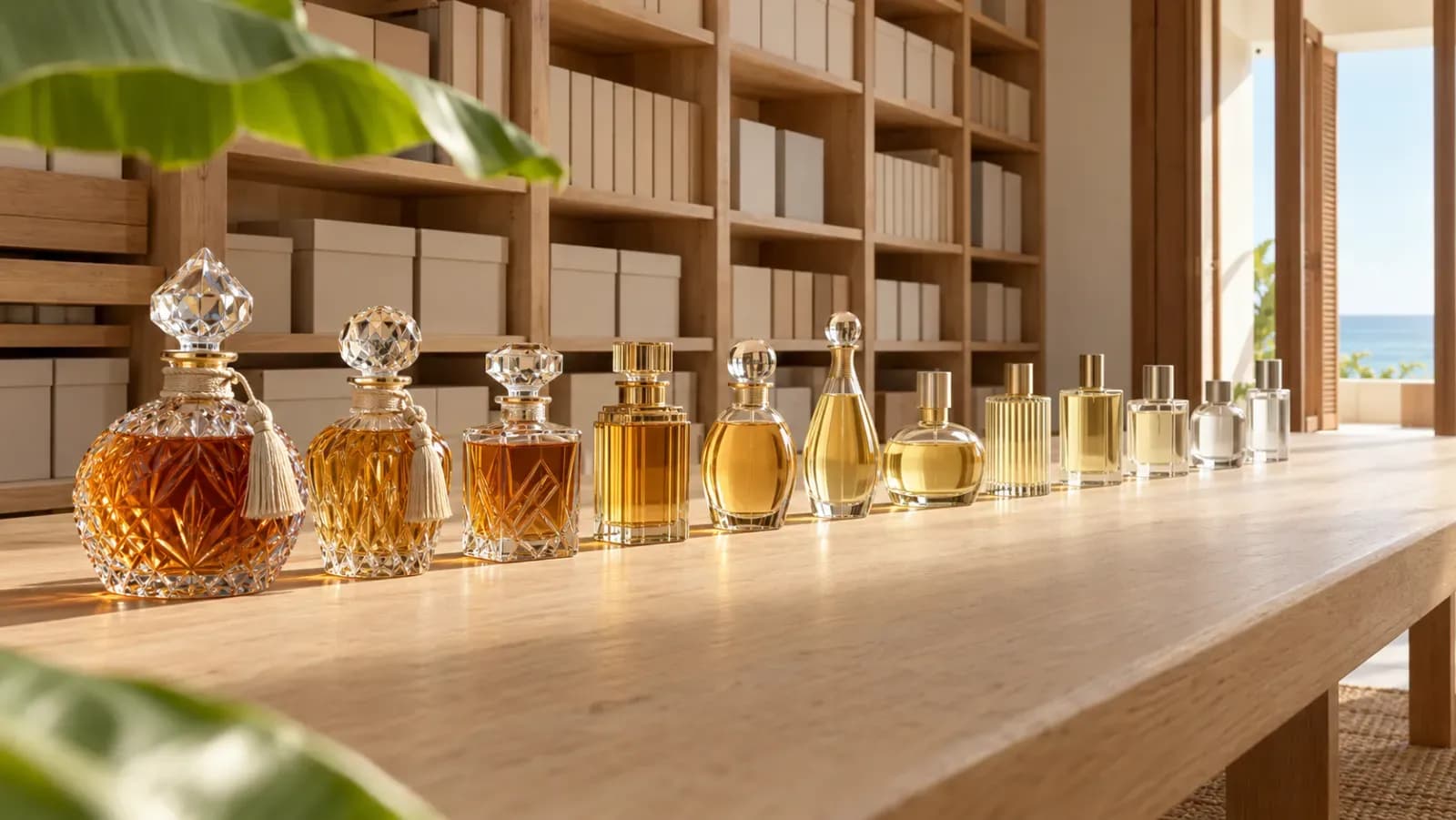
There is a perfume that came out in 1921. In the hundred years since, 68 perfumes have been described as resembling it. Another perfume, launched in 2010, gave rise to 36 look-alikes in just ten years. The first is Chanel No 5. The second is Creed Aventus.
These numbers are not a perfume lover's impressions. They come from a paper published this summer that analysed about 170,000 perfumes released between 1900 and 2024 all at once. The research team treated perfume as a culture that evolves over time, much like music or fashion, and spread 120 years of perfumes out like a single map.
If you have just started making perfume, you have probably wondered about at least one of these:
- Won't the scent feel richer if I add more materials?
- If I recreate a famous perfume, am I already halfway there?
- How on earth do you make a scent that stands apart from everyone else's?
This paper answers all three questions with numbers. And the answers are more interesting than you might expect.
This is the first paper review in the GrassAccord journal. The first half covers what the paper did and what it found. In the second half, we add our own commentary on how people learning perfumery can put these results to use at the perfumer's organ. Unfamiliar terms are explained at the very end, so read at your own pace.
First, what is this paper?
- Title: Cultural Evolution of Perfumes since 1900
- Authors: Vahid Satarifard and six co-authors. The work is centred on the Human Nature Lab at Yale University in the United States, with researchers from the University of Pennsylvania, the MIT Media Lab and Germany's Max Planck Institute for Human Development. The co-authors include Professor Nicholas A. Christakis, well known for his research on social networks, and Christophe Laudamiel, a working perfumer who has been creating fragrances for many years.
- Published: July 21, 2026, on the paper-sharing site arXiv.
- Read the original: arxiv.org/abs/2607.19520 — free for anyone to read (in English), available as both a PDF and a web page.
- Please note: This is a preprint that has not yet gone through peer review at an academic journal. Numbers and interpretations may change during review.
Part of what makes this paper fun is that social scientists, biologists, design researchers and a perfumer formed one team. They looked at perfume not as chemistry, but as a culture that people have passed back and forth and changed together.
Why did we choose this paper as our first review?
When you study perfumery, you often hear things like "perfumes aren't what they used to be" or "they all smell the same." That might be true, or it might not. Until now, people could only argue from their own memories and tastes.
This paper puts that conversation on top of big numbers for the first time. And the result doesn't side with either camp. Today's perfumes really have become simpler, yet at the same time they try far more unfamiliar combinations than before. The feeling that everything is similar and the feeling that everything is new both turned out to be right.
For a beginner perfumer, it is hard to find a better map. Once you know where you stand and which way the industry is heading, it becomes clear what to practise first.
170,000 perfumes: how were they analysed?
Three perfume websites combined
The team combined data from three online sites that collect perfume information: Fragrantica, Parfumo and Aromo. Here is what they gathered:
- 169,759 perfumes
- 8,332 brands
- 3,050 perfumers
- About 25.9 million user votes saying "this perfume smells of this"
The team describes this as the largest perfume dataset studied to date. The main analysis uses data from Fragrantica, the site with the most users, and the other two were used to check that the results hold.
There is one thing you really should know here. This data contains no actual formulas. It only has the note lists that brands published and user votes. So when this paper says perfumes have become "simpler," it means the published note structure has become simpler, not the actual number of materials. The team clearly states this as a limitation, too.
Perfume seen through four lenses
- How complex is it? — They turned into a number how evenly the various notes are blended within a single perfume. The more notes with real presence, and the more evenly they are spread, the higher the value.
- How new is it? — They measured how rare the perfume's note pairings (combinations of two or three notes) had been in the perfumes released before it. The more unfamiliar the combination, the higher the value.
- Who imitated whom? — They linked users' records of "this perfume reminds me of that one" in chronological order to draw perfume family trees.
- Do perfumers influence each other? — They built a network connecting perfumers who had worked together, and checked whether style spreads along those connections.
Just learn two numbers first
The numbers that come up most often in this paper are complexity and novelty. They can sound difficult, so let's get a feel for them with a simple example first.
Picture two perfumes. One is described as containing eight notes in roughly equal weight: rose, jasmine, iris, vanilla, sandalwood, amber, musk and bergamot. The other has just two or three leads, such as cedar and a salty, marine note. The first has high complexity; the second has low complexity. The more notes there are, and the more evenly they are spread, the bigger this number gets.
Novelty asks a different question: "How often have these notes appeared together in the same perfume before?" Rose and jasmine have been used together countless times, so that pairing is not new. But if you pair two notes that have almost never met, your novelty score will be high even with only a few notes.
So it is enough to remember complexity as "how many things did you blend" and novelty as "how unfamiliar a pairing did you make." The fact that these two numbers moved in opposite directions is the paper's first discovery.
Three eras of perfume launches
Before we get into the main results, let's look at the big picture the team drew. When they plotted the number of new perfumes released each year, the 120 years split into three periods.
- Classical perfumery era (before 1926) — A period when launches grew slowly, with one big jump around 1918.
- Stagnation period (1926–1979) — The number of new releases recorded in the data stayed at around 20 a year for a long time.
- Industrial perfumery era (since 1979) — Launches exploded. Growth sped up again around 2014–2018, and today about 6,000 new perfumes pour out every year.
Six thousand a year works out to about sixteen a day. In a market with this many new products, what does it take to stand out? Reading the "newer" result that comes later alongside this number makes it easier to understand.
That said, the paper notes that these era names were given by the team for convenience of analysis and are not terms shared by perfume historians. And since only perfumes recorded on the online sites were counted, the older the perfume, the more likely it is to be missing.
What changed over 120 years?
Some notes faded, others rose
When the team charted the popularity of the 50 most-used notes year by year, some notes held their place no matter how the times changed: musk, jasmine, rose, bergamot, sandalwood and amber. You could call them the backbone of perfume that never went out of fashion in 120 years.
By contrast, some notes moved a lot after the 1990s. Oakmoss and ylang-ylang declined, while vanilla and cedar grew. There is a reason oakmoss declined. Because it can cause skin allergies, the International Fragrance Association (IFRA) reduced its permitted use in stages, and in 1997 it was capped at 0.1% of the finished product.
At the level of accords, the change is even more dramatic. Fruity accords, which started rising in the 1990s, kept growing through the 2000s, while earthy, mossy and aldehydic accords clearly declined. Aldehydes became the most widespread accord of the early 20th century after Chanel No 5 used them, but they went into decline in the early 1990s. The team called this a cultural turning point in perfume aesthetics.
From the age of feminine perfume to unisex
For most of the 20th century, feminine perfumes were the stars of the market. But from the late 1990s, unisex perfumes that ignore the men's and women's divide grew noticeably.
What's interesting is that the gender image of notes did not drift towards neutral. Tuberose, iris, rose and jasmine remained feminine notes, while sage and leather remained masculine. Of the notes that changed meaningfully, about 61% moved from the feminine side to the masculine side. Notes such as styrax, incense, vetiver, oakmoss, lemon and petitgrain crossed the gender line.
The world smells more alike than you might think
When the team grouped perfumes by country, Western Europe, the English-speaking world, Latin America and most of Asia clustered in a "global mainstream" built around fresh, fruity and sweet accords. The most distinct region was the Middle East, with noticeably more oud, amber and warm spicy accords, which the team links to the long tradition of oriental scents. Region explained 13% of the differences in scent between countries by notes and 17% by accords: meaningful, but not large.
Simpler, yet newer
This is probably the result from this paper that will be quoted most.
Around 1990, perfumes became simpler
From 1965 to 1990, perfume complexity was fairly stable at an average of about 3.7. But around 1990 it suddenly began to fall, and from 2000 to 2024 it settled again at about 3.0. This value is measured in a unit called "bits," but remembering the direction matters more than the exact meaning. A smaller number means that the number of notes with real presence in a single perfume has gone down.
Yet at the same time, they became far newer
Simpler does not mean predictable. The novelty of note combinations rose steadily from about 2.3 in the early 1900s to about 7.6 in the 2020s, climbing most steeply from the 1990s onwards. The number of ingredients went down, but the way those ingredients are paired keeps heading somewhere unexpected.
The team also pointed out perfumes at the two extremes.
- The complex but less novel end: Chanel No 5 (1921), Guerlain L'Heure Bleue (1912), Lanvin Arpège (1927)
- The simple but novel end: Jo Malone London Wood Sage & Sea Salt (2014), Maison Francis Kurkdjian Baccarat Rouge 540 (2015), Escentric Molecules Molecule 01 + Mandarin (2021)
One side is made up of masterpieces from a century ago; the other, of the most talked-about perfumes of the last ten years. Put the two groups side by side and the flow of 120 years comes into view at a glance.
Why did perfumes become simpler?
The team does not pin it on a single cause, offering several possible explanations together.
- A sales-driven industry — As mergers and acquisitions created bigger companies, the industry may have moved towards shorter formulas.
- The minimalist movement — Minimalism, which passed through architecture and design (1920s) and art (1960s), may have carried over into perfume.
- The rise of independent perfumers — From the late 1990s, it became easier to source materials and sell perfume online, and independent perfumers multiplied. For someone working alone, a shorter formula is simply more practical to handle.
- The influence of senior perfumers — Perfumers at the centre of the network, like Edmond Roudnitska, who was famous for short formulas, may have led younger generations towards minimalism.
Evidence that regulation pushed new combinations
The team used oakmoss regulation as a kind of natural experiment. When they compared perfumes that had contained oakmoss with those that hadn't, the oakmoss perfumes became simpler and newer as the regulations tightened. No difference showed up at the first restriction in 1988, but by around 2008, when the restriction was at its strictest, complexity had fallen by an extra 0.19 and novelty had risen by an extra 1.20. The interpretation: when the materials you can use are restricted, perfumers find new paths.
Perfumes have family trees too
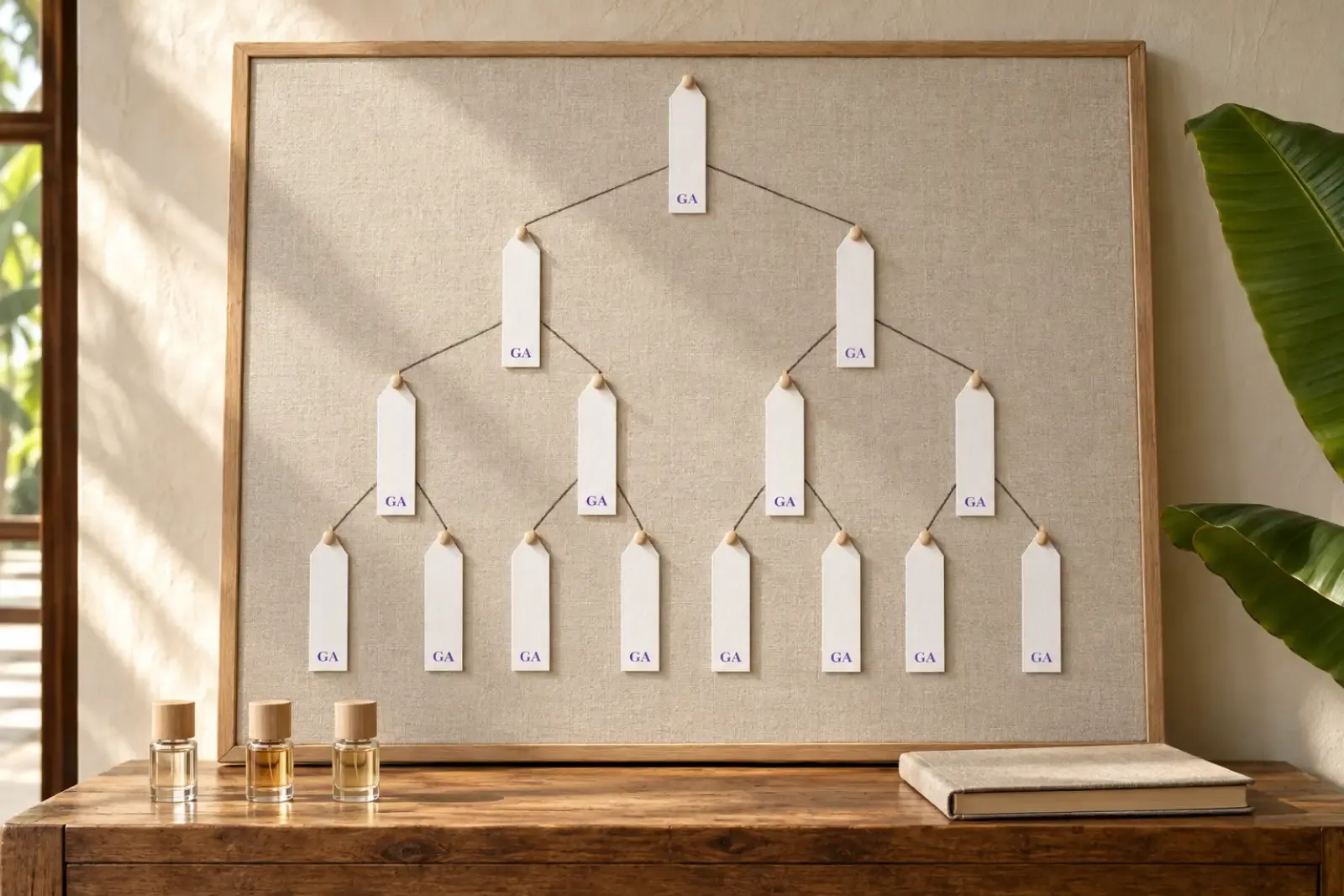
Chanel No 5: 68 in a hundred years. Aventus: 36 in ten
Link users' "this resembles that" records in chronological order and you get a perfume family tree. Rather than relying on a vague sense of similarity, the team kept only pairs whose notes actually overlap heavily (the top 5%) to draw the trees.
The two biggest families are Chanel No 5 and Creed Aventus. Chanel No 5 became the root of 68 perfumes over a century, while Aventus produced 36 in just ten years. Coty Ex'cla-ma'tion, Comptoir Sud Pacifique Aloha Tiare, Givenchy Gentleman (1974) and Robert Piguet Fracas were also named among the most imitated.
Imitation is common, and mostly done by other brands
Of the 2,563 descendant perfumes in the family trees, 62.6% were clones made by other brands and 37.4% were variations (flankers) released by the same brand. And 28.6% had two parents, meaning they bring two perfumes to mind at once, which the team compared to a hybrid in biology. Across the whole market, clones were estimated at a minimum of 1.0–11.7%. The figure depends on how strictly you define resemblance.
But the way imitation works has changed
The team also counted how many "notes worth copying" there were in each era. It was 36% in 1965–1984 and 34% in 1985–2004, but dropped sharply to 7% in 2005–2024. In 1985–2004 in particular, people even tended to avoid scent motifs that had already become common.
This means today's perfumes are moving towards choosing new notes for themselves rather than simply following famous perfumes. The degree to which perfumes shook up existing trends peaked around 2000 and has since shifted towards gradual consolidation.
Originals and clones: how big is the difference really?
If you love perfume, this is probably the part you are most curious about. The team compared 123 original perfumes, 2,222 flankers and 12,028 clones using user ratings. Here are the numbers:
- Longevity (how long the scent lasts): originals 3.45, clones 3.26
- Sillage (how far the scent spreads through the air): originals 3.10, clones 2.95
- Overall rating: originals 4.05, clones 3.96
- Value for money: clones were slightly higher, but the difference was not statistically significant
- Flankers: fell between originals and clones on every measure
In short, originals came out ahead on all three measures, by about 0.1–0.2 points. The team gave two possible reasons why clones were rated lower. It could be because cheaper materials were swapped in, or because price and brand name influenced people's judgement. This study could not tell which.
Longevity moved ratings the most
The team also looked at what is linked to ratings. The strongest link was longevity. Sillage and novelty, on the other hand, were actually linked to ratings in the opposite direction. Value for money had no meaningful link.
Style spreads three steps away
Perfumery has always been solitary work
For a long time, a perfume was the work of a single perfumer, the so-called "nose." In this respect, the team says, perfume is closer to painting than to music. In fact, collaborative perfumes made up only about 8–15% each year, and that share actually fell from about 13% in the 2000s to about 8% in 2010–2020.
Working together makes you alike
The largest cluster in the perfumer collaboration network had 500 people. Perfumers who worked together grew to resemble each other's styles. The effect was strongest between direct collaborators and weakened at two and three steps away. According to the team, beyond three steps they were even less alike than perfumers picked at random. Influence flowed more from highly renowned perfumers to less renowned ones.
The strongest reason for working together was experience at the same brand. And the work of perfumers with collaboration experience shook up existing trends less than the work of perfumers working alone. You could say that working together polishes you, while working alone makes you stand out.
Commentary: what this paper tells people learning perfumery
From here on, this is GrassAccord's interpretation, not the paper's conclusions.
Adding materials is not the same as skill
When you build your first formulas, empty space makes you nervous, so you add one material, then another. This paper shows that over the past 30 years, the whole industry has moved in the opposite direction. The number of notes fell, and the combinations became newer instead. Baccarat Rouge 540 and Wood Sage & Sea Salt were loved not for the number of materials, but for their unfamiliar pairings.
When you practise, limit yourself to ten materials or fewer and complete a single accord. Once you get into the habit of checking whether the scent collapses when you remove one material, you will be able to explain why each material is there. Building up those explanations is what skill is.
Learn the backbone that doesn't change
Musk, jasmine, rose, bergamot, sandalwood and amber, which held their place for 120 years, make a great textbook for beginners. Trendy notes change in ten years, but a feel for handling these six lasts. Smell each one on its own, then try them in pairs, and let your body remember their personalities.
Restrictions become a starting point for new ideas
The oakmoss story applies to beginners just as well. There will always come a time when a material you want to use is regulated or hard to find. If you shift your thinking from "now I can't make it" to "let's create a similar impression another way," your own combinations will emerge from that process. Deliberately banning one material and practising without it is good training, too.
Use famous perfumes as a starting point
The finding that originals and clones differ by 0.1–0.2 points can be read two ways. It means a well-made clone is rated quite close to the original, and it also means the original is consistently rated a little higher.
GrassAccord also sells formulas that use well-known perfumes as study material. That is why we have reported these numbers as they are, without shrinking or inflating them. The approach we recommend is to treat a famous perfume as a starting point, not an answer key. Once you understand its structure, swap one material, shift the proportions a little and grow it into your own scent. It also fits the current trend the paper revealed: choosing for yourself rather than copying. And remember that one of the possible reasons clones were rated lower is the materials. Even with the same structure, material quality changes the result.
Design scents that last
The finding that longevity is most strongly linked to ratings is a practical hint. You can read it to mean that the drydown still there hours later leaves a bigger impression than the dazzle of the first few minutes. Don't judge a blotter right away; get into the habit of smelling it again after an hour and after half a day.
On the other hand, stronger sillage did not mean higher ratings. One possible reading is that designing a scent that smells good up close for a long time beats making it carry far.
Who you learn with shapes your style
The finding that style spreads three steps away means your learning environment matters. If you only smell and learn within the same teacher and the same group, your scents can easily start to sound alike. Seek out scents made by perfumers from other schools and scents loved in other regions. The world of oud and amber loved in the Middle East shows a grammar quite different from the global mainstream.
And treasure your time working alone, too. In this paper, perfumers who worked alone shook up trends more. Learn together, create alone now and then. That balance is what builds your own voice.
Three exercises to try at your perfumer's organ
It would be a shame to read the paper and stop there. We have picked three exercises you can try at your perfumer's organ tomorrow. Set the proportions to suit your own materials and taste.
Exercise 1. Complete one scent with five materials
Set out exactly five materials and complete a single scent. When you are done, remove the materials one at a time and sort out which ones make the scent collapse when removed and which make little difference. If a material makes no difference, that means you could put a more meaningful material in its place. This is the fastest way to learn, hands-on, how today's simpler perfumes are made.
Exercise 2. Find a pairing you have never tried
Lay out the list of materials you use often and pick two you have never once used together, then pair them. Most won't work. But about one time in ten you'll have that "oh, this is actually nice" moment. Write that pairing down in your notebook. The novelty this paper talks about starts with pairings like these.
Exercise 3. A half-day smelling journal
Dip three blotters in the same scent and smell them right away, after an hour and after half a day, writing down your impressions each time. A scent you loved at first may be gone after half a day, and one that seemed flat at first may shine later. This exercise trains your senses for longevity, the measure most strongly linked to ratings.
Things to keep in mind when reading this paper
- It is a preprint. Numbers and interpretations may change as it goes through journal review.
- It analysed note lists, not formulas. It is based on notes published by brands and user votes, so it may differ from actual material compositions. The team also states that they could not confirm whether the same results appear in actual materials.
- Ratings are site users' votes. Longevity, sillage and ratings are values from people's votes, not measuring instruments.
- Clone identification also relies on user records. Because it starts from records saying "this reminds me of that perfume," not every clone was found.
- There is little data from before 1965. Perfumes from 1900–1965 make up less than 2% of the total, so trends in that period are uncertain.
- Discontinued perfumes are missing. With no records of discontinuations, the study could not analyse which perfumes survived in the market.
- The causes are still hypotheses. The explanations given for why perfumes became simpler are the team's possible interpretations and, apart from the oakmoss case, have not been tested directly.
Words used in this article
- Note — Each individual scent you can smell in a perfume, named like lemon, rose or vanilla.
- Accord — A unit of scent in which several materials are blended so they read as a single impression.
- Aldehydes — A family of materials that give a bright, sparkling feel, like soap or freshly pressed linen. They became famous through Chanel No 5.
- Longevity — How long a scent lasts after you apply it.
- Sillage — How far a scent spreads into the air around the body. The word comes from French.
- Original — In this paper, an earlier perfume that other perfumes imitated.
- Flanker — A variation released by the same brand that carries on the original perfume's name and impression.
- Clone — A perfume made by another brand to resemble an existing one.
- Oakmoss — A material obtained from a lichen that grows on oak trees. It gives a deep, forest-floor scent, and its use is restricted due to allergy concerns.
- IFRA — The International Fragrance Association, which sets usage limits for fragrance materials.
- Formula — The blueprint that records which materials are blended in what proportions to make a scent. It is what GrassAccord sells.
In closing
Spread 120 years of perfumes out on a single page and you can see that perfume, like music and fashion, has changed by following trends and growing to resemble one another. Aldehydes faded and vanilla rose, the age of feminine perfume widened towards unisex, and 68 perfumes branched out from Chanel No 5 alone.
And the current direction is clear: fewer ingredients, newer combinations, and scents that last.
For anyone just starting out in perfumery, this is good news. You don't need dozens of expensive materials; in this era, skill means finding new pairings with just a few. One day, your perfume may sit at the top of someone's family tree. Scent is a universal language. GrassAccord will be with you as you take your first steps in writing your own sentences in it.
Paper source: Vahid Satarifard, Fabian Baumann, Geetanjali Minsky, Laura Sisson, Lou M. Haux, Christophe Laudamiel, Nicholas A. Christakis. "Cultural Evolution of Perfumes since 1900." arXiv:2607.19520, published July 21, 2026 (before journal peer review). Original: https://arxiv.org/abs/2607.19520 (DOI 10.48550/arXiv.2607.19520) · All numbers in this article are taken from the paper's main text and supplementary materials; the wording is GrassAccord's summary and commentary. The "Commentary" section is GrassAccord's interpretation, not the paper's conclusions. Perfume and brand names are trademarks of their respective owners.