Paper Reviews ·
Scent Mixtures: Why Words Beat Molecules — GrassAccord Reads the Paper "Predicting the Distance Between Scent Mixtures"
Can you know in advance how differently two scent mixtures will smell? We walk through a PNAS paper on an olfaction challenge contested by 26 teams worldwide, explained for beginner perfumers. The strongest predictor turned out to be not molecular structure but the words we use to name smells.
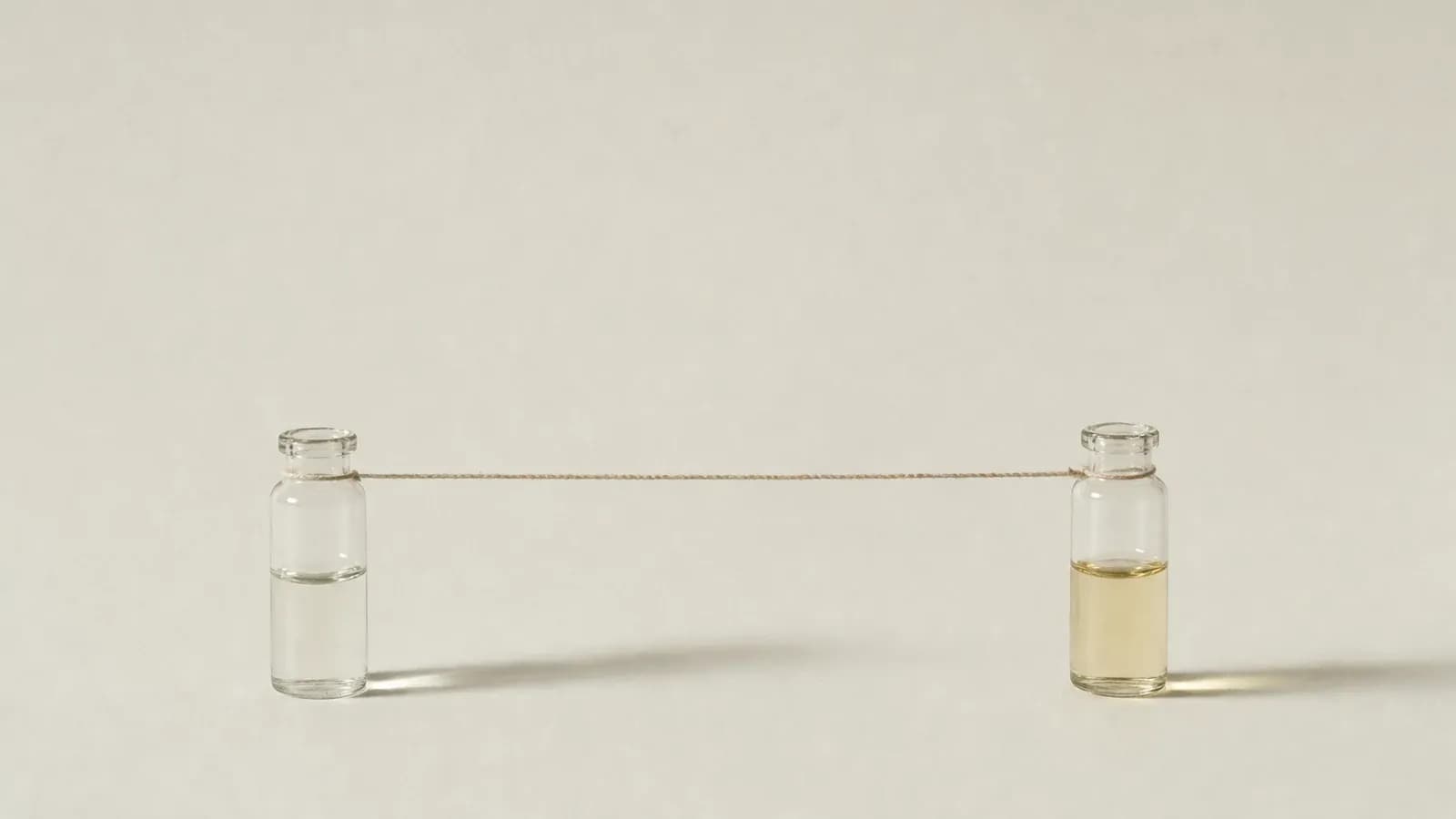
Imagine two blotters held just under your nose. One carries a scent mixture of 10 molecules. The other is also a mixture of 10 molecules, and the two share not a single molecule. Yet to the human nose, they smell rather alike.
Why does this happen? And could you know the result before you blend? A paper published this August in the Proceedings of the National Academy of Sciences (PNAS) is the record of 26 research teams from around the world taking on this old question together.
The result was unexpected. The best key to predicting how a mixture smells was not reading the shape of its molecules directly. Predictions were most accurate when they passed through the words we use to name smells, like "fruity" or "grassy".
If you have just started making perfume, you have probably wondered about at least one of these:
- Does writing a scent down in words really improve my skill?
- Two scents seemed alike yesterday but different today. Is something wrong with my nose?
- Will AI soon be composing accords for us?
This paper offers hints on all three questions. The first half covers what the team did and what they found. In the second half, we add our own commentary on how people learning perfumery can put these results to use at the perfumer's organ. Unfamiliar terms are explained at the very end, so please read at your ease.
First, what is this paper?
- Title: A semantic-based community model for high-fidelity tuning of olfactory mixture distances (a shared model that uses the meaning of words to fine-tune the distances between odour mixtures)
- Authors: A large collaborative team centred on Vahid Satarifard and Pablo Meyer. Institutions from several countries took part, including Yale University, The Rockefeller University, the Monell Chemical Senses Center, the Weizmann Institute of Science and IBM Research. Leslie B. Vosshall, Noam Sobel and Joel D. Mainland, all well known for their olfaction research, are also co-authors.
- Published in: Proceedings of the National Academy of Sciences (PNAS), volume 123, issue 32, published August 4, 2026. This paper has been through journal peer review.
- Read the original: doi.org/10.1073/pnas.2611057123 — free for anyone to read (in English).
- Please note: This study deals with research mixtures of molecules, not perfumes. The authors themselves mention perfume design only as one possible future application.
Why did we choose this paper?
In our first paper review, we looked down on about 170,000 perfumes through numbers. That was a map of markets and culture. This time we go in exactly the opposite direction, looking closely at the nose of one person sitting in front of two blotters.
Perfumery, in the end, is the work of blending. Yet the rules that exist for the eyes and ears do not yet exist for the nose. Red, green and blue make the colours on a screen, and sound can be described by dividing it into frequencies. The research team says that smell still has no comparable framework. That is why perfumers have long relied on experience and their noses.
This paper lays the first fairly sturdy bridge across that gap. It is not a finished bridge. But because it shows honestly how far we have come and where the bridge breaks off, it makes good study material for anyone learning perfumery.
Can the sense of smell be mapped?
Before getting to the main content, let's look at why this challenge was held in the first place.
Predicting the smell of a single molecule has got quite good
Predicting a smell from molecular structure alone was long a notoriously hard problem. But the past 10 years have changed things. The first DREAM olfaction challenge showed that computers could predict smell descriptions like garlic, sweet and flowery from molecular structure.
In 2023 came a model called the Principal Odor Map (POM), a map that places molecular structures in a space of smells. According to the paper, this model did better at predicting smell descriptions than the median person on a panel. Many teams in this challenge used this very map as an ingredient.
But most of the world's smells are mixtures
The trouble comes next. The smells we meet in daily life, like coffee, flowers and perfume, are usually mixtures of dozens or hundreds of molecules. Predicting one molecule is of little use in the real world if you cannot predict what happens when molecules are mixed.
If you have tried perfumery, you know this difficulty well. Sometimes you blend two good materials and get a scent nothing like what you expected, and sometimes a material you added seems to vanish. A public benchmark for predicting mixtures was needed, so a challenge was held in which many teams competed on the same problem.
How did the 26-team olfaction challenge work?
Scattered experiments were brought together
The team first combined six datasets from three studies that had been carried out separately. Combined, the scale looks like this.
- 168 single molecules
- 731 different mixtures
- 507 measurements comparing two mixtures
Because the experiments had been run in different ways, all the results were moved onto a single scale. 0 means the two scents cannot be told apart, and 1 means they could not be more different. The team calls this number the distance between smells. Just as you would measure between two cities on a map, you measure between two scents.
Key figures
Scattered experiments combined: 731 mixtures
Challenge data merging six datasets from three studies onto one scale
Source: Satarifard et al., PNAS 123(32), 2026 · Compiled by GrassAccord
Three months of competition
The challenge is called a DREAM Challenge, a format in which several teams openly compete on prediction skill using the same problem. The 26 teams refined their AI models for about three months, then sat a final test on 46 mixture pairs with the answers hidden.
Teams could submit practice problems up to three times a week and see their scores. During the challenge, 159 practice predictions were submitted, and 19 teams went on to enter the final test.
The contest did not end cleanly. Four teams, D2Smell, UMich CASI, ChemSenSim Lab and belfaction, tied for first place. The research team believes that with only 46 test pairs, it would have been hard to separate them. So instead of picking one team, they built a combined model that averages the predictions of the top six models. This combined model is the star of the paper.
Flowchart
A tie for first, and the combined model takes the lead
About three months of competition, then validation afterwards
Source: Satarifard et al. (2026) · Compiled by GrassAccord
Checked twice by human noses
It was human noses that marked the AI's answers. There were two tests.
- First test (New York, The Rockefeller University) — 34 people took part. 92 mixtures formed 46 pairs, and each mixture was made of 10 components with no overlap between the two in a pair. A triangle test was used, in which people pick the one bottle out of three that smells different.
- Second test (Philadelphia, Monell Chemical Senses Center) — 16 people took part after the challenge had ended. 59 newly designed mixtures formed 50 pairs, with 9 to 11 components per mixture. People directly scored how similar two scents were.
The second test had a neat safety check. Participants compared a garlic-smelling molecule with a pineapple-smelling molecule, and a strawberry-scented molecule with itself. They judged the first pair far apart and the second pair very close. That is evidence the scale was working properly.
Table
Human noses marked the answers, twice
Confirmed again with a new site and method
| First test | Second test | |
|---|---|---|
| Site | The Rockefeller University | Monell Chemical Senses Center |
| Participants | 34 | 16 |
| Mixtures | 92, in 46 pairs | 59, in 50 pairs |
| Components per mixture | 10 | 9–11 |
| Method | Triangle test | Similarity scoring |
Source: Satarifard et al. (2026), Materials and Methods · Compiled by GrassAccord
Just two numbers to learn first
Two numbers keep coming up in this paper. They may seem difficult, so let's get a simple feel for them.
The correlation coefficient shows how much the prediction and reality move in the same direction. At 1 they move together perfectly, and at 0 there is no relationship at all. A value of 0.61 does not mean 61% correct. It is enough to think of it as the model generally marking as more distant the pairs that people felt were more distant.
The average error (RMSE in the paper) shows how far, on average, a prediction strayed from the actual distance. Smaller is better. At 0.08, the prediction is off by roughly that much on the 0-to-1 scale.
So remember the correlation coefficient as "does it get the order right?" and the average error as "how close are the values?"
How accurate was the combined model?
It far outperformed existing methods
In the first test, the combined model recorded an average error of 0.08 and a correlation coefficient of 0.57. Compared with leading existing methods, the error fell by about 33% and the correlation coefficient rose by 53%. It also beat every individual team's model in the challenge.
One point deserves attention here. After the challenge, the team built a new model using only the features that looked most important. This model could not catch up with the combined model and stayed at the level of the top individual teams. The team's interpretation is this: picking good ingredients is not enough, and only by bringing different approaches together can you reach that level.
Key figures
The combined model beat existing methods
Change from leading existing methods on the 46 pairs of the first test
Closer to 1 is better for correlation; smaller is better for average error · Source: Satarifard et al. (2026) · Compiled by GrassAccord
It held up on unseen problems
A model that only solves challenge problems well is of little use. So after the challenge it was tested again on 50 newly designed pairs. The combined model's average error grew to 0.13, but it kept up good performance. That matters, given that the test site, the participants and the test method were all different.
Results varied by problem type
The 46 pairs of the final test were divided into three groups: 16 randomly made pairs, 20 pairs designed by people to feel similar, and 10 pairs matched to be similar by an existing distance calculation. The teams did not know which pair belonged to which group.
The combined model's average error was small on the two designed groups, at 0.07 and 0.06, and 0.10 on the random group. The correlation coefficient went the other way: slightly higher on the random group at 0.45, and 0.38 on the other two. The team added that because the number of pairs is small, the numbers for small groups should be read with care.
Why did words beat molecular structure?
This is probably the result that will be quoted most from this paper.
Keeping only the words made it better
The team ran an experiment that removed ingredients from the model one at a time. They took out all the molecules' chemical features, the information on the receptors in our bodies and the mixture information, leaving only the information that corresponds to the words we use to name smells.
The result was surprising. The words-only combined model scored a correlation coefficient of 0.61 and an average error of 0.075 in the first test, actually better than the combined model that used every ingredient. In the second test too, its correlation coefficient of 0.54 was 15% higher.
Conversely, the model without words got much worse. In the first test its correlation coefficient fell to 0.41, and in the second test it came close to the level of guessing by chance.
Graph
Remove the words and it collapses; keep only the words and it improves
Correlation coefficient in the first test · closer to 1 is better
In the second test, the model without words fell close to the level of chance · Source: Satarifard et al. (2026) · Compiled by GrassAccord
What does "words" mean here?
This part is easy to misread, so let's be precise. It does not mean people smelled the mixtures and wrote down smelling notes that were fed in. The computer looks at a molecule's structure and first predicts "what would people call this molecule?" It assigns probabilities to 138 words such as fruity or grassy. The combinations of words obtained this way are then used to compare two mixtures.
In other words, it does not go straight from molecule to smell distance. It passes through a way station made of words. What is remarkable is that these words were learned from pure single molecules, not mixtures, and yet they explained the distances between mixtures well.
The team takes one step further here. It may be that the smell of a mixture is not produced by a fundamentally different principle from the smell of a single molecule. The hard part may lie less in the "mixing stage" than in the "stage of going from molecule to smell". The paper also notes, however, that some researchers disagree with this view.
Diagram
Not straight from molecule to distance, but through words
These are words predicted by a computer, not people's smelling notes
Simplified diagram; details vary by team · Source: Satarifard et al. (2026) · Compiled by GrassAccord
Which words carried the most weight?
One team grouped the 138 words into 12 clusters. In that team's model, the clusters with the greatest influence were fruity, grassy and herbal, and nutty, oily and roasted.
Results differed by word too. In the same team's analysis, green, clean and cognac were linked with a reduction in error, while violet, aromatic and natural were linked with an increase. The research team drew a line here, saying these results are hard to interpret directly. Still, it is interesting that a word as broad as "natural" appears in the list. This part is our own impression, not the paper's conclusion.
Table
Some words reduced error, others increased it
Link between word influence and error in one team's model · the researchers are cautious about interpreting it
Linked with lower error
Linked with higher error
Source: Satarifard et al. (2026), Fig. 3B · Compiled by GrassAccord
You don't need many ingredients
For each model, the team stacked up the features with the greatest influence, one after another. Among the most accurate models, three reached half of the total influence with fewer than 100 features. One model needed about 1,000, so the difference is large. This means that explaining smell distance does not necessarily call for a great many complicated ingredients.
How consistent is the human nose?
The human record is the ceiling
This is the most honest part of the paper. The team also measured how often the same people give the same answer when they judge again. In the second test, participants judged twice at least a day apart, and the correlation coefficient between the two results was 0.74. In the first test, the value from splitting the data in half and comparing was 0.69.
If you think about it, this is only natural. Even averaged human judgement does not repeat perfectly. So it is hard for a model to match people better than people match themselves. The words-only model's 0.61 and 0.54 have not yet reached this ceiling. The team admits that a gap remains between the model and people.
Graph
Models have not yet reached human repeatability
Correlation coefficient · for people, agreement when the same judgement is measured again
First test
Second test
The two tests used different methods and are not compared directly · Source: Satarifard et al. (2026) · Compiled by GrassAccord
Models fail on very similar or very different pairs
The models were most accurate at distances of 0.5 to 0.8, because that is where the training data is concentrated. Randomly blended mixtures are said to fall mostly in this range.
Below 0.5 or above 0.8, by contrast, the error grew. The models showed a habit of pulling predictions towards the middle. They guess very similar pairs to be a little further apart than they really are, and very different pairs to be a little closer.
This matters to perfumers. The hardest judgement in practice is telling apart two trial blends that are "almost identical yet somehow different". That is exactly where today's models are weakest.
Scale
Strong in the middle, weak at both ends
Model error across smell distance, from 0 (indistinguishable) to 1 (most different)
Telling apart trial blends that are "almost identical yet somehow different" is a judgement at the left end
Training data is concentrated at 0.5–0.8 · Source: Satarifard et al. (2026) · Compiled by GrassAccord
The new model did not always win
When the second test was split into five bands by distance, the earlier model, the Principal Odor Map, had the smaller error in the most similar band. In the other four bands, the combined model and the words-only model led. This shows that a good overall average does not mean good results in every band.
How is this different from real perfume?
It would be a problem to carry this study straight over to perfume. There are big differences between lab mixtures and real perfumes.
- Mixtures matched for intensity — In most of the data, the intensity of the components was matched in advance. In a real scent, strong components mask weak ones, and character changes with concentration. The team wrote that handling intensity is a task for the future.
- Number of components — The test mixtures had around 10 components. The team explains that the smells we meet in daily life are usually mixtures of dozens or hundreds of molecules.
- A limited range of materials — The range of molecules used is narrow. Whether the approach works on unfamiliar molecules is not yet known.
- A judgement of one moment — This study asked how similar two scents are. It did not ask how a scent changes over time, or whether people like it.
Please keep the last item in mind especially. Distance says only how different two scents are. It does not tell you which one smells better.
There is one piece of welcome news. The team has made its data, models and code public. That means anyone can test a better method on the same problem. But being public does not mean there is now a tool where a perfumer can enter two accords and get a distance straight away. For now it is closer to a baseline for researchers.
Comparison
A lab mixture is not a perfume
Four things to remember when applying this study to perfume
| This study | Real scents | |
|---|---|---|
| Intensity | Mostly matched in advance | Strong components mask weak ones |
| Components | Around 10 | Usually dozens to hundreds of molecules |
| Range of materials | Limited molecules | Much wider |
| What is asked | How similar are two scents? | Change over time, and good or bad too |
Source: Satarifard et al. (2026), Discussion · last row is GrassAccord commentary · Compiled by GrassAccord
What is an olfactory metamer? Different materials, same scent
One of the datasets used in the paper came from a study that set out to create olfactory metamers. A metamer is a pair of mixtures that smell similar even though they share no components. In colour terms, it resembles the way light of different compositions can look like the same colour.
The team expects that these results will make it possible to generate virtual metamers efficiently on a computer and test them. The order would be to pick candidates by calculation first, then have people confirm them.
The applications the authors list are broad: digital olfaction that stores and transmits smell as data, technologies that monitor health through breath and other signs, electronic noses, and generative fragrance design. These are future possibilities, however. This paper did not actually design a perfume.
Commentary: what this paper tells people learning perfumery
From here on, this is GrassAccord's interpretation, not the paper's conclusions.
Writing a scent in words is design, not appreciation
In perfumery classes, many people find it tedious when asked to keep notes on materials. Why write it down, they ask, when you can just smell it? This paper invites a second look at that habit, because a handful of smell words explained the distance between mixtures better than a mass of molecular information.
Of course, a computer's words and a person's notes are not the same. Still, they point the same way. Once you divide a scent into words, you can compare it. A note that ends in "nice" is no use for your next blend, but a note that says "strong grassy smell, wet wood left at the end" is.
Start by learning single materials
The words were learned from single molecules, and yet they explained mixtures. The order of learning perfumery is the same. If you know the impression of a single material clearly, you can read what happened when it was blended. Time spent smelling one material many times pays off more later than making a lot of accords.
It is worth borrowing one method from the lab here. Just as the team matched the intensity of the components, match the dilution when you compare materials. If only one side is strong, you are comparing intensity rather than the character of the materials. Judgements made on undiluted materials often change once you smell them diluted.
Choose words with a narrow meaning
"Natural" is a convenient word, but it holds a lot. Go one level further down and ask what exactly is natural about it. Write down whether it is the smell of cut grass, wet soil or a freshly peeled fruit. As mentioned earlier, the paper does not prove this, but you can quickly confirm at the organ that the narrower a word's meaning, the more useful it is for your next judgement.
Build the same impression with different materials
The idea of the metamer is a great comfort to beginners too. Even if a material is unavailable or restricted by regulation, you can rebuild the same impression with different materials. Smelling similar does not necessarily require the same molecules.
Many of the formulas GrassAccord sells also take famous perfumes as study material. But similar and identical are not the same thing. What this study dealt with, too, is the impression of one moment. How a scent changes over time is something you have to watch for yourself, with a blotter in front of you.
Trust your nose, but not just once
Even averaged human judgement scores 0.74 when measured again. If two scents that seemed alike yesterday seem different today, it may not be because something is wrong with your nose. Judgement wavers by nature. Smell again a day later before any important decision, and compare with the note you wrote first. It is habit, not numbers, that protects your judgement.
Several noses beat one
The best performer in this paper was not one outstanding team but the average of different teams. Smelling is similar. When you cannot make up your mind alone, ask someone else to smell. A single "smells like soap" from someone who knows nothing about perfumery can turn out to be a precious hint.
AI only narrows down the candidates
The future this study points to is less a world without perfumers than one where calculation narrows down the candidates and people decide with their noses. The model has not yet judged good from bad, and it was weak in the hardest zone of "almost identical yet different". For the time being, that last stretch remains the place of the human nose.
Three exercises to try at your perfumer's organ
It would be a waste to stop at reading the paper. Let's scale down what the team did and bring it to your perfumer's organ. Set the proportions to suit your own materials and taste.
Exercise 1. Build your own scent vocabulary
Choose ten materials you use often and dip a blotter in each, one at a time. For each material, write down just three words. Leave out words of judgement like "nice", and use only words that point to a smell, such as fruit, grass, wood or soap. A week later, cover the names, write again and compare. The words that remain are the material's true face.
Exercise 2. A triangle test at home
Prepare two similar trial blends. Dip two of three blotters in the same trial blend and one in the other, marking the underside. Ask someone to shuffle the order, then try to pick the odd one out. If you keep getting it right over many tries, the two are distinct scents. If your hits stay at the level of guessing (one in three), they are nearly the same scent to your nose for now.
Exercise 3. Measure your own nose's distance
Write down the distance between two scents as a number between 0 and 1, where 0 means you cannot tell them apart and 1 means completely different. Score about five pairs, then score them again the next day in the same order. Seeing how much the numbers move tells you the range of your judgement. It is fine if they waver. Knowing that range is the point of this exercise.
Things to keep in mind when reading this paper
- This is not perfume research. It dealt with research mixtures of molecules. That does not mean it applies directly to perfume formulation.
- There are not many test problems. The first test has 46 pairs. That is why the top teams could not be ranked, and the team advises reading the results for small groups with care.
- It is strong in the middle range. The training data is concentrated at distances of 0.5 to 0.8, so it is weak on very similar or very different pairs.
- The data mixes measurement methods. Triangle tests and scoring were moved onto one scale, so bias from the method may remain.
- Intensity was not fully handled. Most of the components were matched for intensity. In real scents, intensity is a major variable.
- It may not work on new molecules. The range of molecules used in the tests is narrow.
- The interpretation has dissenters. The paper states that some researchers disagree with the view that a mixture's smell is largely determined by the overlap of its words.
- Corporate advisory ties are disclosed. The paper states that some authors advise companies related to olfaction.
Words used in this article
- Single molecule — A scent substance made of one kind of molecule.
- Mixture — A blend of several molecules. In this study, around 10 components.
- Distance — A value from 0 to 1 showing how different two smells feel. 0 means they cannot be told apart, and 1 means most different.
- Triangle test — A way of measuring the ability to discriminate by having someone pick the odd one out of three.
- Correlation coefficient — A number showing how much two values move together. The closer to 1, the more they move together.
- Average error (RMSE) — The average size of a prediction's departure from reality. Smaller is better.
- Combined model (ensemble) — A single model made by averaging the predictions of several models.
- Word information (semantic features) — Values a computer predicts for which smell words a molecule would be called.
- Principal Odor Map (POM) — A model from earlier research that predicts smell words from molecular structure. Many teams in this challenge used it as an ingredient.
- Metamer — A pair of mixtures that smell similar even though their components do not overlap.
- Accord — A unit of scent in which several materials are blended so they read as a single impression.
- Formula — The blueprint that records which materials are blended in what proportions to make a scent. It is what GrassAccord sells.
In closing
The nose still has no rule like red, green and blue. But the first clue that 26 teams found together lay, unexpectedly, on the side of human language. A few words for smells explained the distance between two scents better than long descriptions of molecules.
And measuring that distance to the very end is still the work of the human nose. Noses waver, and models lean towards the middle. Because neither is perfect, the most reliable method even now is to smell slowly in front of a blotter, write it down in words, and smell again the next day.
For anyone just starting out in perfumery, this is good news. Even without expensive equipment, blotters and one notebook are enough to set out on the path this study points to. Scent is a universal language. GrassAccord will be with you as you gather its vocabulary, word by word.
Paper source: Vahid Satarifard, Laura Sisson, Yikun Han et al. "A semantic-based community model for high-fidelity tuning of olfactory mixture distances." PNAS 123(32), e2611057123, published August 4, 2026. Original: https://doi.org/10.1073/pnas.2611057123 · All numbers in this article are taken from the body of the paper, and the text is GrassAccord's summary and commentary. The "Commentary" section is GrassAccord's interpretation, not the paper's conclusions.