Research ·
2026 Niche Perfume Outlook Report — Ten Fronts, Read by GrassAccord at the Perfumer's Bench
The fragrance market is cooling, yet niche keeps growing — and the niche names are being bought by big capital. So what is the real asset that remains in niche? We read the ten fronts of 2026 from the perfumer's bench.
In October 2025, the Spanish fragrance group Puig reported its quarterly results and said two things in the same breath: the fragrance market had grown weaker than before, and its own niche fragrances were still growing at double digits. That same month, L'Oréal agreed to buy Kering's beauty business, home to the niche house Creed, for 4 billion euros.
The market is cooling, yet niche keeps growing. And the niche names are being taken by big capital. So what is the real asset that remains in niche?
GrassAccord has one answer. A name can be bought and sold, but the design of a scent stays with those who understand it. In our first research piece of 2026, we set out to test that answer across ten fronts.
This report does not watch the market from the outside; it reads it from the perfumer's bench. For each front we set down the facts that can be verified today and our own interpretation, and at the end we place a section called "At the bench". "At the bench" is written for three seats: those who have just begun mixing materials, those who have begun building their own accords, and those who have been designing scents for many years. Whichever seat is yours, there is a line here to take with you.
Before you read — a principle about numbers
There is no shortage of studies sizing the niche fragrance market, but their figures differ by nearly a factor of ten. Do they count only independent houses, or include niche brands acquired by large groups, or even the high-end lines of fashion houses? The scope of "niche" changes from one study to the next.
So this piece does not lead with market-size figures. We use only signals that can be traced back to a source and verified: published results, confirmed deals, regulations actually in force. Trends drawn from industry reporting are named as trends and not stated as certainties. The piece is based on material published up to late January 2026.
The ten fronts at a glance
- 1. Pace of growth — The great boom ends, growth normalizes · Task at the bench: Compete again on the finish of the scent
- 2. Big capital — Niche houses move inside large groups · Task at the bench: Design, not the name, is the difference
- 3. Dupes — From the margins to the centre · Task at the bench: Reading an impression as a structure
- 4. The Middle East — A culture of rich, long-lasting, layered scent · Task at the bench: A feel for designing strength and longevity
- 5. China and Korea — Home-grown niche houses on the rise · Task at the bench: Turning the memory of one's culture into scent
- 6. How scent is worn — High concentration, minis, layering, skin scents · Task at the bench: Structures that hold when layered
- 7. The note map — Nutty gourmands, restrained tropicals · Task at the bench: The skill to hold trend notes in check
- 8. Regulation — Expanded EU fragrance allergen labelling · Task at the bench: Designing within safety standards
- 9. Materials and costs — Price swings, tariffs, new production methods · Task at the bench: The flexibility of knowing substitutes
- 10. Paths to discovery — Scent is first met on a screen · Task at the bench: Confirming on a blotter, not in words
What niche perfume once meant
Niche originally means a gap, a small corner. In perfumery it came to describe houses that put the scent itself at the centre, as distinct from designer fragrances launched under the name of a fashion house. Diptyque, which opened in Paris in 1961 and released its first fragrance in 1968, and L'Artisan Parfumeur, founded in 1976, are often cited as the starting point. They spoke through scent rather than advertising, and made the fragrances they wanted to make rather than the ones most likely to sell.
From the 2000s onward niche grew quickly, and from the 2010s acquisitions by large groups followed one after another. Today the word niche wavers between two meanings: "a small, independent house" and "an expensive fragrance". In the end, the ten fronts converge on a single question. In 2026, is niche still a niche, or has it simply become "expensive perfume"?
Front 1. The end of the great boom, and normalization
According to the US market research firm Circana, sales of prestige fragrance in the United States rose 12% in 2024. Even while other beauty categories stood still, fragrance grew at double digits. In the first half of 2025 prestige fragrance still grew 6%, but over the same period mass fragrance rose 17%. Mass accounts for only about 10% of total fragrance sales, yet it has begun to outpace prestige in speed, and Circana expects prestige fragrance to keep growing in 2026–2027 but to fall short of double digits.
The fragrance companies' own figures paint the same picture. Puig's growth in the third quarter of 2025 was led by makeup and skincare, while growth in its fragrance division slowed sharply. Yet in the same announcement, chairman and CEO Marc Puig said that niche has grown faster than the overall fragrance market for more than a decade and remains a growth engine for the group's brands. At Estée Lauder too, there were reports that while total fragrance sales fell in early 2025, Le Labo posted double-digit growth.
The boom ran on four fuels. Through a period of long days at home, scent became "a small luxury for myself"; a younger generation began keeping several fragrances like a wardrobe and switching between them; men entered the market in earnest; and short videos turned scent into something you "see". These forces have not disappeared. But as more people already own several bottles, the pace of new purchases slows, and as prices rise, more people look for the more sensible option.
So the moment is less "fragrance has gone cold" than "coming down from a fever and finding its normal temperature". Some of those who came in on the trend are drifting toward lighter options, while those who have truly fallen for scent are going deeper. And those who go deep eventually start to ask: how was this scent built?
At the bench
A period in which the finish on the blotter, not the advertising budget, once again decides the game is, if anything, an opportunity for small houses and independent perfumers.
- If you are mixing for the first time — Rather than making many, take one blend and refine it all the way. Split the same mix before and after maturation and record your impressions in the first few minutes, after an hour and the next day; you will begin to see how a scent moves through time.
- If you are building your own accords — Ask whether the reason people come back to your scent lies in the top, the heart or the drydown. Once you know where the scent catches people, it becomes clear what to refine.
- If you have been designing for years — In a period when new briefs grow scarce, variations on your signature work are an asset. Building versions on the same skeleton for different seasons, concentrations and uses is also a way of making the structure one step more precise.
Front 2. Big capital knocks at the door of niche
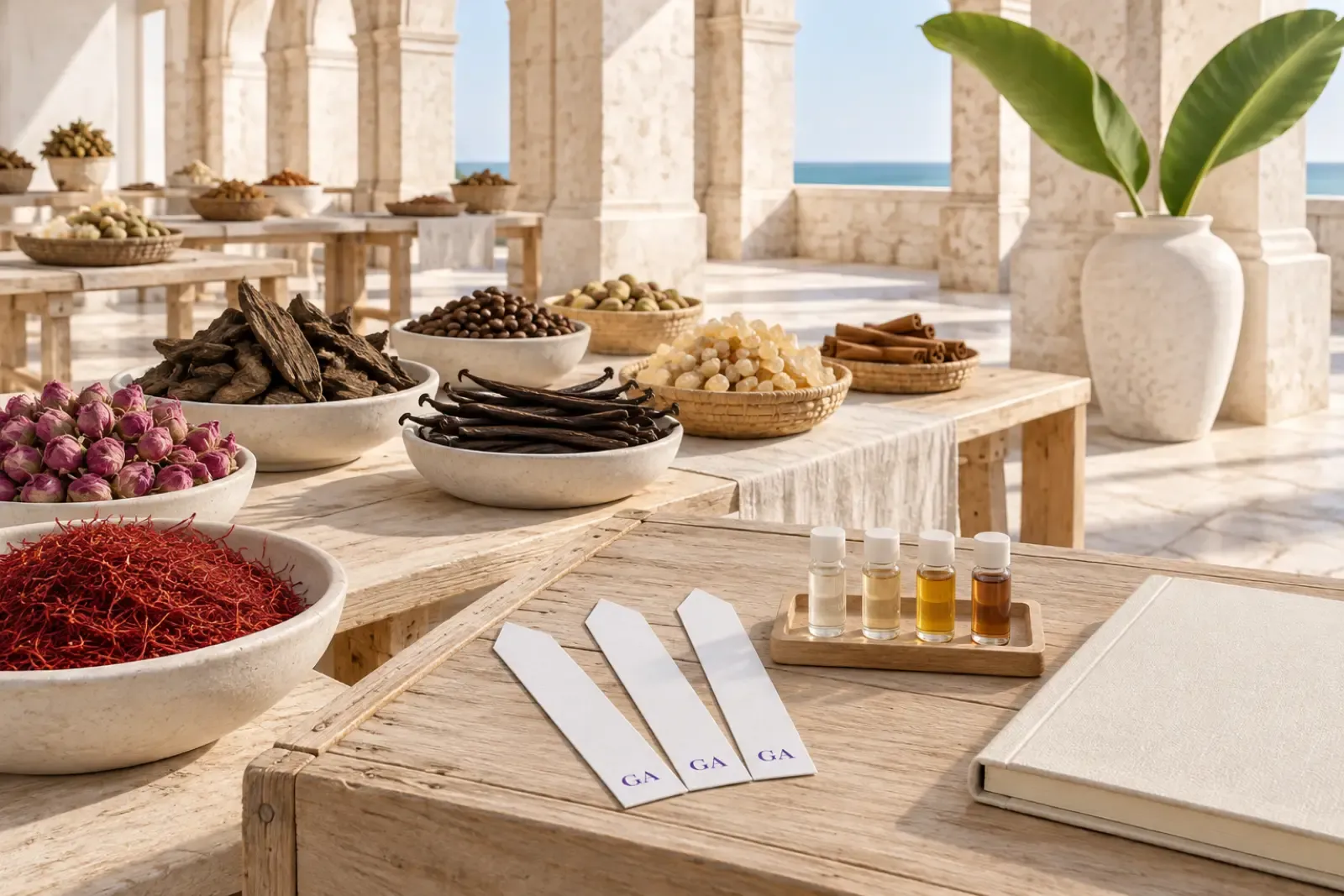
Over the past decade or so, niche fragrance has become the asset large groups covet most.
- Estée Lauder acquired Le Labo in 2014, Editions de Parfums Frédéric Malle in 2015 and Kilian in 2016.
- Puig bought a majority stake in Byredo in 2022.
- Kering acquired Creed in 2023 for around 3.5 billion euros and took a stake in Matière Première in 2024. That same year, the investment firm Eurazeo invested in Ex Nihilo.
- In October 2025, L'Oréal agreed to acquire Kering's beauty business, including Creed, for 4 billion euros. L'Oréal said it could quickly grow Creed's annual sales nearly threefold, and the deal is set to close in the first half of 2026.
In June 2025, Byredo founder Ben Gorham left the brand, as planned at the time of the acquisition. It was the image of a founder who had embodied the niche boom stepping down inside a large group.
When big capital arrives, the stores spread to airports and department stores and the advertising grows. The scent reaches more people. By the same token, the stubbornness and experimentation a house once had, the willingness to make something even if it does not sell, easily fade. People who love scent have already noticed the difference. Rather than the "niche" label, they now ask who made the scent, and with what intent.
At the bench
The more the value of the niche name is absorbed by big capital, the more the difference returns to the design of the scent itself.
- If you are mixing for the first time — Choose one scent you love and smell other works by the perfumer who made it. Not the name of the house but the habits of a hand begin to show: the materials always leaned on, the drydown always left behind.
- If you are building your own accords — For each of your scents, write down "why this material". As the reasons behind your designs accumulate, they become the grammar of your own house.
- If you have been designing for years — After an acquisition, it is not unusual for a scent to be quietly reformulated for reasons of cost, supply or regulatory compliance. Documenting the original structure and the reasons for choosing it is the surest way to protect a scent.
Front 3. Dupes are no longer on the margins
Scents that carry the impression of a luxury perfume at a far more sensible price, commonly called "dupes", have moved from the margins to the centre in just a few years.
The most visible name is Lattafa, a fragrance house from Dubai. With sensible prices, strong projection and a broad social media following, it has established itself in the US market. Spate, a company that tracks search interest, named Lattafa alongside YSL Beauty as the fragrance brands with the fastest-growing interest in the United States in mid-2025. By the same measure, Lattafa's search volume was up about 69% year on year, and its TikTok interest about 138%.
Creators have driven this trend. Dupes that people once kept quiet about are now discussed openly, in side-by-side videos comparing "how close is this scent to that luxury perfume". Duping has begun to be seen not as something to be ashamed of but as a smart choice, and this trend also lies behind the rapid growth of mass fragrance we saw in Front 1.
On the surface, it is a story about price. We read it a little differently. That dupes are loved means people have begun to care about the structure of a scent more than its name. Anyone who sets two scents side by side and asks "why are they alike?" and "where do they part ways?" is already halfway to analysing scent.
Even duping has its lines. What causes problems is usually not the scent itself but the name, the trademark, the bottle shape and the packaging. Using the original brand's name in a product name or advertising, or making a bottle and box confusingly similar, can raise issues of trademark and unfair competition. As the market grows, so will the voices asking "where does inspiration end and copying begin?" And the spread of dupes has put one question to the whole industry: strip away the bottle, the box and the advertising, and what is the scent itself worth?
At the bench
This is why GrassAccord hands over formulas. If someone buying a dupe stops at "a scent that resembles", someone holding the formula can understand its structure and take a step toward a scent of their own.
- If you are mixing for the first time — Dip the original and the dupe on two blotters side by side, and smell them again at 10 minutes, an hour and the next day. Finding the point at which two scents that began alike part ways is your first lesson in reading structure. Usually the first impression is alike, and the difference shows in the drydown.
- If you are building your own accords — Look for two or more paths to the same impression. When you can build the same impression from a different combination of materials, recreation becomes interpretation rather than imitation.
- If you have been designing for years — Take a recreation as a starting point, but make it clear where you made a different choice from the original; that is your signature. Leaving a different drydown on the same impression — that choice outlasts any name.
Front 4. The centre of scent widens eastward — the Middle East
For a long time the benchmark for perfume was France, Italy and a handful of European houses. Today industry reporting names the Middle East as one of the forces shaping the fragrance landscape of 2026.
Middle Eastern scent culture begins from a different place. It favours rich, long-lasting scents such as oud, amber, rose and saffron; it applies attars, fragrance carried in oil without alcohol, to the skin; and it lets the smoke of smouldering fragrant wood chips infuse clothes, hair and the home. Attar on the skin, smoke in the fabric, perfume on top: scent is built up layer by layer on the body and in the space. Scent is not decoration but a courtesy to one's guests.
This culture is spreading worldwide not only through value-led houses like Lattafa but also through top-tier houses such as Amouage of Oman. One wholesaler reports that in Western Europe oud is no longer an exotic import but has settled in as a branch of fine fragrance.
This is not just a story of "Middle Eastern brands selling well". It means a second standard for judging scent has emerged. Beside the European standard, which prized a scent that lingers softly on the skin, a standard of rich, long, layered scent has begun to stand. The preference for layering and high concentrations in Front 6 is linked to this current.
At the bench
Knowing how to handle oud, amber, saffron, rose and musk is becoming a basic competence of perfumery in 2026, and a feel for designing diffusion and longevity matters more than ever.
- If you are mixing for the first time — Natural agarwood oil is extremely rare and costly, so most oud scents on the market are accords that build its impression from several materials. Start by understanding oud not as a single material but as an "impression" in which wood, smoke, leather and a touch of animalic overlap.
- If you are building your own accords — The richer the scent, the more it matters to leave it room to breathe so it does not sink. The same oud-and-rose skeleton can read as heavy or as transparent depending on the bright materials placed on top.
- If you have been designing for years — An alcohol-free oil base evaporates slowly and keeps its diffusion close to the skin. Move a structure designed as an alcohol-based perfume into oil and the presence of the opening and the balance of the drydown both change, which makes this a good year to build the same scent in both bases and compare them side by side.
Front 5. Asian niche awakens — China and Korea
In China, home-grown niche houses are growing fast. Documents, which champions an Eastern sensibility, opened its first flagship in Shanghai in 2021 and has since expanded into top-tier retail districts such as Beijing SKP. To Summer went abroad by opening its first store in Hong Kong in September 2025, and that same year Melt Season opened a duty-free store at Tokyo's Narita Airport, the first for a Chinese fragrance brand.
The global beauty giants have already moved. Estée Lauder invested in Melt Season at the end of 2023, and L'Oréal in To Summer in early 2024. With foreign brands still holding an overwhelming share of the Chinese fragrance market, the growth of home-grown houses has only just begun. Puig, too, named the expansion of niche in Asia-Pacific as a growth driver.
In Korea, over the past few years, houses such as Tamburins, Nonfiction and Granhand have established themselves by crafting scent, space and sensibility together. A culture of enjoying scent for its own sake, rather than as an accessory to fashion or cosmetics, has spread quickly, above all among younger people.
These houses do not simply follow the grammar of European niche. They translate the memories of their own culture into scent — tea, wood, the air after rain, old paper — and explain it in their own words. Niche is no longer the story of one continent but a stage on which many cultures each present their own scent.
At the bench
This current matches exactly the principle we believe in. It need not be in English: perfumers who compose in the language of their own culture have begun to take the world stage. That is also why GrassAccord guides its formulas in 30 languages.
- If you are mixing for the first time — Choose one smell from memory, such as a childhood kitchen, an alley on a rainy day or a favourite cup of tea, and write down in words the elements that make it up. That list becomes your first brief.
- If you are building your own accords — Rather than leaning on familiar Western note names, try describing the scent in your own words. Not "fig" but "unripe fruit in a yard at the end of summer". A scent you can describe is a scent you can design.
- If you have been designing for years — The more a scent carries the memory of a place, the more it needs a universal skeleton that reaches noses beyond that place. Putting uniqueness in the details and universality in the structure is the next task for Asian niche.
Front 6. Richer, layered, closer — how scent is worn is changing
It is not only how people choose scent but how they wear it that is changing.
- Higher concentrations. According to Circana, products with higher concentrations, such as eau de parfum (EDP) and parfum, drove the largest share of prestige fragrance growth. For the same price, people look for a scent that lasts.
- Smaller, and more of them. Gift sets containing mini sizes and travel sets have grown sharply. Circana expects demand to split between high concentrations on one side and lighter formats such as minis and body sprays on the other.
- Layering. Building a personal drydown by layering body oils, hair mists and perfume appears in every 2026 trend report. The idea is to lay down a weighty base scent and add lighter scents on top according to mood, and brands themselves recommend layering lotions and even deodorants in the same scent to extend longevity.
- Scents that stay close to the skin. Rather than scents that project far, soft musks, clean white florals and skin-like scents that can only be felt up close are drawing attention.
- Scents you carry with you. Formats for touching up during the day, such as solid perfumes, roll-ons and small mists, are on the rise.
These currents converge on one point. Rather than wearing a single scent exactly as someone else defined it, people want to assemble scent to suit their own body and mood. We are moving from an era in which a bottle of perfume was a finished work to one in which the wearer completes the final combination. Layering is, in truth, the entrance to perfumery. Anyone who has layered two scents to create a new impression soon wants to try it at the level of raw materials.
At the bench
- If you are mixing for the first time — Raising the concentration does not make a scent better. Dilute the same blend at two or three concentrations and compare them on blotter and on skin. You will learn first-hand that diffusion and longevity come not only from concentration but from how quickly the materials evaporate.
- If you are building your own accords — A scent designed for layering must be complete on its own and must not collapse when layered. Make the drydown of the base scent solid and keep the top and heart of the scent on top clear — design with the roles divided from the start.
- If you have been designing for years — Musk, the heart of skin scents, is a material where it is not unusual for some people to barely perceive a particular musk at all. The closer a scent stays to the skin, the more it needs to be checked by many noses, and the more it calls for a design that layers several musks of different character to fill that gap.
Front 7. The note map shifts — sweetness turns nutty, tropicals turn restrained
Lay the trend reports published ahead of 2026 on top of one another, and the note map is moving like this.
- The gourmand changes direction. Gourmands remain strong, but they are shifting away from the sugary sweetness of cake and candy toward the nutty and bittersweet: coffee and espresso, pistachio, hazelnut, rum. Plainer notes such as rice and milk are also newly in the spotlight.
- Rising notes. Raspberry and saffron are named as key notes for 2026, and spicy, warm notes such as ginger are frequently mentioned.
- Tropical restraint. Tropical notes such as mango, coconut, pandan, banana leaf and tamarind have begun to be used with refinement rather than resort-style exaggeration.
- Divided views on vanilla. Vanilla is still loved, but some perfumers declare that "the era of quiet vanilla is over" and herald more dynamic scents.
- The young move on. There are also reports that younger consumers are moving away from fresh citrus toward scents that are unfamiliar, intense and almost edible.
Sweetness has not disappeared; it is maturing. Resistance to unfamiliar notes is falling and curiosity is rising. As we saw in Fronts 4 and 5, this is also the result of scent's cultural horizon widening.
At the bench
A trend note is not the answer to "what should I put in?" but homework on "in what balance should I use it?" The good scents of 2026 will be decided not by how many trend notes they contain but by how well they hold them in check.
- If you are mixing for the first time — Notes such as pistachio, milk and rice are rarely obtained by extracting a material of that name. Usually several materials are gathered to build the impression. The moment you know that a note's name and the actual materials differ, your eye for reading scent rises a level.
- If you are building your own accords — A nutty note that runs over even slightly drags the whole scent toward food, and a tropical note that is even slightly overdone turns it into a cheap souvenir. When building an accord, decide first whether that note is the lead or a supporting player.
- If you have been designing for years — Lactones, which give a milky softness, and pyrazines, which give a roasted nuttiness, change the direction of the whole scent in tiny amounts. Rather than setting a trend note front and centre, hiding it as a single layer of texture within a familiar structure is what stays loved for longer. Trends pass; structure remains.
Front 8. The regulatory clock — July 31, 2026
There is one date in the 2026 fragrance industry that is more firmly set than any other: July 31, 2026.
In 2023 the European Union amended its cosmetics regulation (Regulation 2023/1545), greatly extending the list of fragrance allergens subject to mandatory labelling. Dozens of substances were added to the existing list, and some existing entries were changed. Above 0.001% in leave-on products and 0.01% in rinse-off products, they must be named in the ingredient list. According to the text of the regulation, products that do not comply with the new labelling may be newly placed on the EU market only until July 31, 2026, and products placed on the market before then may be made available only until July 31, 2028. Anyone actually selling in Europe should check the detailed conditions for each product against the original text and with specialists.
The United States is moving too. The Modernization of Cosmetics Regulation Act (MoCRA), enacted in December 2022, requires the US Food and Drug Administration (FDA) to issue rules on labelling fragrance allergens. The statutory deadline for the proposed rule (June 2024) has passed and no specific rule has yet appeared, but the direction is the same as in Europe. The ingredients that once sat behind the single word "fragrance" are revealing their names one by one.
The International Fragrance Association (IFRA) published its 51st Amendment to the IFRA Standards in 2023. The standards banning or restricting materials changed, and the deadline for existing fragrances to comply with the restrictions, October 30, 2025, has already passed.
For large groups these changes are manageable; for small houses they are heavy homework. Ingredients must be re-analysed, labels reprinted and, in some cases, scents reformulated. In 2026 some small houses may scale back European sales, discontinue older scents or quietly reformulate. The more natural materials a scent uses, the heavier the burden, because even a single natural essential oil naturally contains several substances subject to labelling.
At the bench
A good formula is not only one that smells good but one designed within safety standards. Even a scent made for personal use stops being someone else's concern the moment you give it as a gift or sell it.
- If you are mixing for the first time — Read once what IFRA standards and allergens are. Simply knowing that familiar natural essential oils contain substances subject to labelling, such as linalool in lavender and limonene in citrus oils, changes the way you look at materials.
- If you are building your own accords — When buying materials, make a habit of obtaining the IFRA certificate of conformity and the allergen declaration from the supplier. On the day you start selling your scent, they will be your greatest asset.
- If you have been designing for years — IFRA standards divide products into categories by type, so the same material has different limits depending on where it is used. If you plan to release the same scent as both a perfume and a body product, building the skeleton from the start around the strictest category reduces later reformulation.
Front 9. Materials and costs — prices swing, production changes
The raw material market that makes up the cost of a scent is quietly moving as well.
- Natural materials swing. In 2017, cyclone damage and rising demand combined to push Madagascar vanilla to a record price of more than 600 dollars per kilogram. Since then, rising production across several origins has pushed supply well above demand, and by 2025 prices had fallen sharply on oversupply. Natural materials can swing again at any time with the weather, the harvest and conditions at origin.
- Tariffs. Under the tariff agreement between the United States and the European Union in July 2025, a 15% tariff has applied to most European imports since that August. Most European perfumes and cosmetics, which had previously faced almost no tariff, were included. Large groups have room to absorb it, but for small houses it becomes a choice between raising prices and cutting margins.
- New production methods. The major fragrance companies have been increasing the share of materials once obtained from plants or animals that are now made through biotechnology processes such as microbial fermentation. The advantages are a stable supply and a lighter environmental footprint.
- Artificial intelligence. Companies have emerged that use AI to analyse the relationship between fragrance molecules and smell, and the major fragrance companies have long used digital tools to assist perfumers. It has not reached the stage of replacing perfumers, but it is changing the speed of material exploration and testing.
Materials are becoming available in greater quantity, more reliably and in more diverse ways. The ability to weave those materials into a single impression in the right balance, however, remains in the perfumer's hands. That is why the value of scent is shifting from "the value of materials" to "the value of design".
At the bench
The more material prices swing, the stronger a design that does not depend on any single material.
- If you are mixing for the first time — Smell natural and synthetic materials from the same family side by side. There is no right answer as to which is better. Naturals are rich in texture; synthetics have a clean, stable line. Knowing the role of each is the starting point.
- If you are building your own accords — For each material you use often, write down two or three candidates that could replace it. Then even if one material cannot be found, the scent does not stop.
- If you have been designing for years — A fermentation-derived material or one from a new supplier can have a subtly different impression even under the same name. When changing a material in a signature work, always set the two side by side and compare them through maturation before switching. The difference often shows in the drydown.
Front 10. Paths to discovery — scent is first met on a screen
Scent is something you know only by smelling it. Yet today many people meet a scent on a screen before they meet it with their nose.
Reviews, comparison videos and short-video recommendations are now among the most powerful paths to purchase. Lattafa in Front 3 is hard to explain without creators and comparison videos. More people choose scents by the ratings and note information on fragrance communities such as Fragrantica, and digital recommendation tools and personalized consultations that help people who buy without smelling first are on the rise.
That information has opened up is clear progress. Notes, materials, even the names of perfumers are now available to anyone. At the same time, a trap has appeared: scent consumed only in words. The words "vanilla and wood" on a screen may be the same while the actual scents are entirely different. The more a screen feeds curiosity, the more the wish grows to smell, compare and make for oneself.
At the bench
There is no surer confirmation than composing for yourself the scent you saw on a screen.
- If you are mixing for the first time — The note list shown on screen is often a set of words chosen to convey the impression of the scent, and may not match the materials actually in the blend. Rather than treating the list as the answer, check it for yourself on a blotter.
- If you are building your own accords — Gather the expressions that recur in reviews of a scent you love. When you know what people actually feel in that scent, the language to describe your own scent falls into place too.
- If you have been designing for years — Narrowing the gap between the blotter, the skin and a one-line description on a screen is now part of design as well. This is an era of building structure while thinking about the words in which a scent will be passed on.
Three paths
The ten fronts do not move separately. Sketched as three paths, these are the directions niche perfume can take in 2026. Rather than any one being the answer, it is likely that all three will unfold a little at a time, simultaneously.
Niche moving up
Niche houses that have joined large groups move toward being more expensive, more lavish and more widely sold. Limited editions, numbered bottles and collaborations multiply, and niche comes to mean "top tier" rather than "a niche". Value comes from scarcity, story and the store experience.
Dupes rising from below
Dupes and value-led Middle Eastern houses bring more people into the world of scent. Some of them begin to go beyond a borrowed impression and have scents in their own name. High concentrations, unfamiliar notes and bold compositions come down into wider price ranges.
Perfumery widening sideways
Some of those who bought scent cross over to composing it. People who have combined scents through layering, people whose curiosity about structure was sparked by comparison videos, people who want to preserve the memory of their own culture in scent — they begin looking for materials and formulas. Beside the market for buying scent, a market for composing scent grows.
GrassAccord stands on the third path. And we believe that as the first and second paths widen, the third widens with them. The more people encounter scent, the more people want to know how that scent was built.
The 2026 calendar
- First half of 2026 — Target for completing L'Oréal's acquisition of Kering's beauty business (including Creed). The direction Creed takes inside a large group is one to watch for the niche industry.
- July 31, 2026 — The EU fragrance allergen labelling rules start to apply. Label changes and reformulations by houses selling in Europe may cluster around this date.
- Second half of 2026 — The year-end gifting season. About 40% of US fragrance sales fall in the fourth quarter. This season will show how well niche holds up in a normalizing market.
- July 31, 2028 — The deadline for making available products placed on the market before the new labelling rules.
Six things to watch this year
- Does the gap between prestige and mass fragrance growth widen further, or narrow again?
- Do niche houses that have joined large groups protect the character of their scents, or focus on store expansion?
- Do dupes begin to go beyond a borrowed impression and compose scents in their own name?
- How far do Middle Eastern and Asian houses establish themselves beyond their home markets, especially in Europe?
- How many scents are discontinued or reformulated after the EU labelling rules?
- How far does the line between people who buy scent and people who compose it fade?
Terms used in this report
For those who have just begun perfumery, here are brief explanations of the terms used in this report.
- Niche perfume — Fragrance from a house that puts the scent itself at the centre, as distinct from a fashion brand's designer fragrance. Today it is used in two senses at once: "a small, independent house" and "an expensive fragrance".
- Concentration — The proportion of fragrance compound in a perfume. It generally rises, and lasts longer, in the order eau de toilette (EDT), eau de parfum (EDP), parfum. Exact thresholds vary from house to house.
- Projection, diffusion and drydown — The way a scent first rises, the strength with which it spreads around you, and the final scent that remains on the skin over time.
- Top, heart and base — The order in which a scent reveals itself over time: the notes that lift off first, the notes that form the core, and the base that lasts longest. The heart is also called the middle.
- Accord — A blend of several materials made to read as a single impression. It is like a chord in music.
- Blotter — A paper strip dipped in fragrance for smelling. Also called a smelling strip.
- Layering — Wearing several scented products on top of one another to create a scent of your own.
- Gourmand — A fragrance family that evokes things to eat, such as vanilla, caramel, coffee and nuts.
- Oud — A scent obtained from the resin formed when the agarwood tree is wounded, or an accord built from several materials to recreate that impression.
- Dupe — A fragrance that carries the impression of a famous perfume at a more sensible price.
- Formula — The blueprint that sets down which materials are blended in which proportions to compose a single scent. It is what GrassAccord hands over.
- IFRA Standards — The standards set by the International Fragrance Association that ban or restrict fragrance materials so they can be used safely.
- Fragrance allergens — Fragrance substances that can cause skin reactions in some people and must be labelled among the ingredients above a certain concentration.
In closing — GrassAccord's 2026
We return to the opening question. If big capital takes the names of niche, what remains in niche?
Across the ten fronts, the answer we found was the same. The cooler the market, the more the finish of a scent matters; the further dupes spread, the more its structure matters; the more regulation and material prices waver, the more flexible design matters. The year in which people who buy scent become people who want to understand it — that is how we read 2026.
And so this year, GrassAccord keeps doing the same work.
- We hand over the blueprint. Not a finished bottle but a formula; not the result but the process.
- We guide you in your language. We deliver our formulas and their guidance in 30 languages, so that if you have a sense for understanding scent, the door to perfumery stays open whatever language you speak.
- We keep recording. In our next research piece, we will choose one of the ten fronts covered here and look at it more deeply.
If you have any questions about the currents discussed in this report or about blending, please reach out to our Concierge at any time. Our perfumers will answer you in your language.
Sources: Circana US beauty market releases (2024–2025), Puig Q3 2025 results announcement, L'Oréal and Kering deal announcement (October 2025), EU Regulation 2023/1545, the 51st Amendment to the IFRA Standards, industry reporting (Cosmetics Design, GCI Magazine, Cosmetics & Toiletries, Premium Beauty News, Jing Daily, Happi, Essencional and others). Market-size estimates are not cited in this piece because each research firm defines "niche" differently. The regulatory information is general information, not legal advice.