Research ·
What Will Be Different This Christmas from Last? — GrassAccord Compares the Numbers and Prepares for the 2026 Holiday Season
We set last year's holiday report card for the perfume market beside nine months of this year's numbers to forecast what will change this Christmas. We check how strong gourmand really was, compare seven Christmas accords and lay out a schedule for the 70 days that remain.
October 16. Exactly 70 days to go until Christmas.
Perfume companies earn a large share of their annual sales at the end of the year. Last December, the US market research firm Circana said that around 60% of prestige fragrance sales in the fourth quarter come in December alone, and that more than a quarter of that is gift sets. In other words, a year's business is won or lost in its final few weeks.
December 25 falls on the same date this year as last. But a great deal has happened in the market in between. Air routes over the Gulf were shut for a time, and US tariffs were struck down by a Supreme Court ruling, then imposed again under a different law. In Europe, new rules for labelling fragrance ingredients began to apply at the end of July. And people's tastes leaned hard in one direction: towards sweet, nutty scents — gourmand.
So in this piece we have set last year's holiday season against this year's, number by number. We look at what actually happened last Christmas season, what has changed since January, and, as a result, how GrassAccord expects this Christmas to differ. At the end, we have set out by date what to take care of at the perfumer's bench over the 70 days that remain.
Before you read: facts and forecasts are kept apart
- Facts are figures officially published by research firms and companies, along with figures confirmed in industry reporting. Figures confirmed only through industry reporting are marked "according to reports".
- Forecasts are the judgements we have drawn from those facts. They carry a (Forecast) tag, and after Christmas we will come back to check which were right and which were wrong.
- We used only material published up to October 16. Data released in November, such as the holiday outlook from the US retail association, is not yet reflected.
- No actual formula proportions are included. Information on tariffs and regulation is general information only, not legal or tax advice.
The 2025 and 2026 holiday seasons at a glance
- US prestige fragrance: Last year +5% for the year; Circana called it "a sign of normalisation after years of rapid growth". This year, first half +6%, with average price +5% and units flat. (Forecast: rich, expensive scents will lead the season)
- US mass fragrance: Last year +15% for the year, the fastest growth in mass beauty. This year, first half +15% in value and +7% in units. (Forecast: gifts at easy price points stay strong)
- US online holiday sales: Last year $257.8 billion (+6.8%, a record). This year forecast at $275.1 billion (+6.7%), with the mobile share forecast at 57.4% for the whole season and 63% on Thanksgiving Day.
- US total holiday retail: Last year +4.1%. This year forecast at +4.0–4.8% (Deloitte), with per-person gift spending expected to fall 2% (PwC).
- Gulf duty-free: Last year Dubai Duty Free posted record annual sales. This year sales fell sharply after the March war and are recovering slowly. (Forecast: last year's level will be hard to reach)
- EU labelling rules: Last year was a transition period. This year, expanded allergen labelling has applied to new products since July 31, making this the first Christmas under the new rules.
- US tariffs: Last year there were country-specific tariffs. This year the legal basis was struck down by the Supreme Court in February, temporary tariffs followed, and new tariffs have applied since July 24. Rates vary from report to report.
- Scent preferences: Last year gourmand was strong and pistachio was starting to rise. This year gourmand has become the "dominant scent direction" (social analysis), with less sugar and a move towards nutty and salty.
- Vanilla: Last year prices were already falling on oversupply. This year, according to reports, extraction grade has dropped to 2012–13 levels.
1. Last Christmas, revisited in numbers
Before looking ahead to this year, let's get last year exactly right.
Circana's expectations on the eve of the season
On December 4, 2025, in a piece on the holiday fragrance market, Circana expected prestige fragrance sales in the fourth quarter to grow in the low single digits and top $4 billion in the US once again. It named four kinds of product to drive holiday demand: high-concentration parfums, luxury brands, minis and inexpensive body sprays. It also noted that, the holiday season before, one in five US consumers had bought fragrance as a gift.
The report card that followed
Circana's 2025 wrap-up, released on February 10 this year, was rather more subdued. Prestige fragrance grew 5% in value over the year. But in the fourth quarter alone it grew less than makeup or skincare. Circana called this "a sign of normalisation after years of rapid growth".
Mass fragrance, meanwhile, grew by a full 15%, the fastest in mass beauty. Value and units rose at almost the same rate, so this was not a matter of higher prices — more fragrance was actually sold. That many people were looking for scents at an easy price.
Gifts bought on a phone
According to Adobe Analytics, US online sales in November–December 2025 reached $257.8 billion, up 6.8% and a record. Cyber Monday alone accounted for $14.25 billion, and 56.4% of all online sales were made on mobile.
Fragrance was no exception. The trade publication Glossy, citing estimates from the data company Charm.io, reported that more than $162 million worth of fragrance was sold on TikTok Shop last year. That much was sold on a screen where nothing can be smelled — we have entered an era in which how a scent is described in words directly shapes how it sells.
Last year's season elsewhere
- Middle East: According to the Dubai government, Dubai Duty Free's 2025 sales reached a record $2.378 billion. Right up to the end of last year, the Gulf was one of the best places in the world to sell prestige fragrance.
- China: According to reports, total transaction value for November's Singles' Day rose 17.5%, a slowdown from 27% the year before. One brokerage analysis also found that China's fragrance imports rose 21% in 2025.
- Korea: According to figures from the Ministry of Food and Drug Safety, exports of fragrance products rose 46.2% in 2025, the largest increase of any cosmetics category.
Last Christmas in a single line: prestige fragrance slowed its pace, inexpensive scents sold well, gifts were increasingly chosen on a phone, and the Gulf had its best year ever.
2. What has changed since January
Units flat, prices up
What stands out in the first-half figures Circana released on August 11 is less the growth rate than what lies behind it. Prestige fragrance sales rose 6%, but average prices rose 5% while units stayed flat. People did not buy more fragrance; they bought more expensive fragrance. High-concentration products such as eau de parfum and parfum grew at double digits.
Mass fragrance grew 15% in value and 7% in units, keeping its place as the top growth category in mass beauty this year too. The top end is getting pricier and richer, the bottom end more affordable — the split that began last year is continuing. The hardest scent to sell now is one with an in-between price and a blurry personality.
The fragrance houses' order books speak first
Perfume brands order their fragrance compounds months before a launch. That is why the results of fragrance companies give an early view of the market several months ahead. On October 13, the Swiss fragrance company Givaudan announced that its fine fragrance sales for January–September this year rose 15.3% on a like-for-like basis. That came on top of 18.7% growth in the same period last year — another big gain on a high base. In the third quarter alone, the Fragrance & Beauty division grew 13.5%. It means orders for the compounds going into this season's launches and next spring's are piling up right now.
How the big companies' fragrance did
- L'Oréal: In its first-half results, it said fragrance was still growing at double digits. Prada Paradigme led the way, backed by Yves Saint Laurent Libre, Valentino Born in Roma and others.
- Estée Lauder: Fragrance sales for the fiscal year ending in June rose 12% to $2.78 billion, led by Le Labo, Tom Ford and Kilian.
- Puig: In the first half, its Fragrance and Fashion division grew 3.8% and Asia-Pacific 20.9%. It estimated that the situation in the Middle East cut sales by about €14 million (0.6% of the total).
- LVMH: In its October 12 release, it reported that third-quarter Perfumes & Cosmetics sales rose 1% on a like-for-like basis. For January–September, the total was flat.
Fragrance is certainly still one of the strong performers in beauty. But the days of a few years ago, when everyone grew together, are over, and results now vary considerably from company to company.
Korean perfume heading abroad
According to data from the Korea International Trade Association, Korea's perfume exports in January this year came to $6.52 million — the highest for any month since records began in 1988. February followed with $6.24 million, the second month in a row above $6 million. Korea, which for so long only bought perfume from abroad, will this Christmas be sending its scents into the gift boxes of more countries than ever.
3. What research firms forecast for this holiday season
Everything from here on is a forecast.
- Deloitte (September 10): It expects US holiday retail sales from November this year through January next year to grow 4.0–4.8%. The same period last year came in at 4.1%. It expects online to grow 7.5–8.4%.
- Adobe (September 28): It forecasts US online sales for November–December at $275.1 billion (up 6.7%). It expects $12.9 billion on Black Friday (up 9.2%) and about $15.1 billion on Cyber Monday, November 30. It sees the mobile share of spending reaching 57.4% for the season and as much as 63% on Thanksgiving Day.
- PwC: According to reports, a PwC survey expects average holiday gift spending per US consumer to fall about 2%, from $721 last year to $708 this year.
Overall spending rises a little, but what each person spends on gifts falls a little, and the share bought on a phone grows. This will be a Christmas with tighter budgets and more demanding eyes.
4. How this year is likely to differ from last
Based on the numbers above, we have picked out five ways this Christmas is likely to differ from last.
① One good bottle, and several small ones (Forecast)
Ahead of last year's holidays, Circana expected high-concentration parfums and minis to drive holiday demand. In the first half of this year, only prices rose while units stayed flat, and per-person gift budgets are expected to shrink. So we think gift buyers will split more clearly between "one proper bottle" and "several small, easy bottles". The safe, mid-priced set will be the most awkward place to be.
② A quieter season in the Gulf (Forecast)
Last year Dubai Duty Free posted record sales. This year, after the March war, Gulf airports were halted for a time. The trade publication BeautyMatter reported that beauty sales across the six Gulf states fell 30–35% through May, and relayed the industry view that recovery would come gradually rather than in a single bounce. We think Gulf fragrance sales this holiday season will struggle to return to last year's level. Instead, it is worth watching holiday duty-free sales in Singapore and Bangkok, where transit passengers flocked in March.
③ Shipping perfume to the US has become a harder calculation
Last year, country-specific tariffs applied. On February 20 this year, the US Supreme Court ruled the legal basis for those tariffs invalid, but the government immediately imposed temporary tariffs under a different law. From July 24, when the temporary tariffs ended, new tariffs were applied to around 60 economies, including the European Union. These tariffs are also being challenged in court, and reports differ on what percentage actually applies to perfume. For a small house selling perfume into the US, setting holiday prices is far trickier than last year.
④ The first Christmas under the new labelling rules
Last year was a transition period. From July 31 this year, under EU Regulation 2023/1545, products newly placed on the market must label their ingredients according to an expanded list of fragrance allergens. Products placed on the market before then may be sold until July 31, 2028. And that list contains many of the components found in the materials we think of first at Christmas — cinnamon, clove, orange. We go into detail in section 10.
⑤ More gifts chosen without smelling them (Forecast)
Last holiday season, 56.4% of online sales were made on mobile. This year that is expected to reach 57.4% for the season and 63% on Thanksgiving Day. With more perfume gifts bought without anyone smelling them first, words that describe a scent precisely and small sample sets that can be tried at home will matter even more than they do now.
5. Was gourmand really that strong this year?
Gourmand came up in nearly every conversation about perfume this year: the family of scents that call to mind things to eat, such as vanilla, caramel, pistachio, coffee and chocolate. To see how far "this is the year of the gourmand" holds up, we checked the evidence one by one, through five questions.
Have gourmand launches really increased sharply?
Yes, they have. In a June 2025 press release, the market research firm Mintel said the share of gourmand among new fragrance launches worldwide rose 7 percentage points between 2022 and 2024. We could not find publicly available figures for 2025 or 2026.
Are people really seeking out gourmand more?
Yes, if you go by interest. In an April 13 piece, the beauty search and social analytics company Spate called gourmand the "dominant scent direction" and said interest in pistachio scent had risen 852.5% in a year. It said marshmallow, caramel and honey were rising too, and that fresh families were losing ground to warm ones. Note, though, that these figures measure search and social interest, not sales.
Did gourmand sell the most?
We cannot tell. Circana's published 2025 results and first-half 2026 figures contain no separate sales numbers for gourmand or vanilla. The claim that it was the best seller cannot be confirmed from public figures, so we have not made it in this piece.
Did gourmand's popularity push vanilla prices up too?
No, quite the opposite. According to reports, vanilla is in oversupply, and this year extraction-grade prices fell back to 2012–13 levels. However strong demand may be, the price was set by supply.
Is gourmand on its way out?
It is changing shape rather than fading. Spate said "simply sweet scents are getting less response", and a Givaudan perfumer told a trade publication in an interview that the pistachio trend is the beginning of salty scents, with grains such as rice and sesame next in line.
The data confirms that gourmand was the scent that drew the most attention this year. But it is not quite last year's gourmand. This year's gourmand is taking out sugar and moving towards the nutty and the salty.
Why this year?
Mintel's analysts suggested that, with appetite-suppressing drugs in wide use, more people are eating fewer sweets and seeking out sweet scents instead. It is an intriguing interpretation, but it has not been confirmed by sales data. A more certain reason seems to be the phone screen. In a video that cannot carry smell, a scent described as a taste — "pistachio cream", "toasted caramel" — is far easier to imagine. That may also be why TikTok Shop fragrance sales and interest in gourmand rose together over the same period.
When it meets Christmas
Christmas has always been a day filled with the smell of food: gingerbread, mulled wine, roasted chestnuts, hot chocolate. With this year's gourmand trend layered on top, we think this season's scents will lean further towards food than last year's (Forecast). If this year's direction holds, they will be closer to toasted grains, roasted nuts and salted caramel than to a coating of sugar.
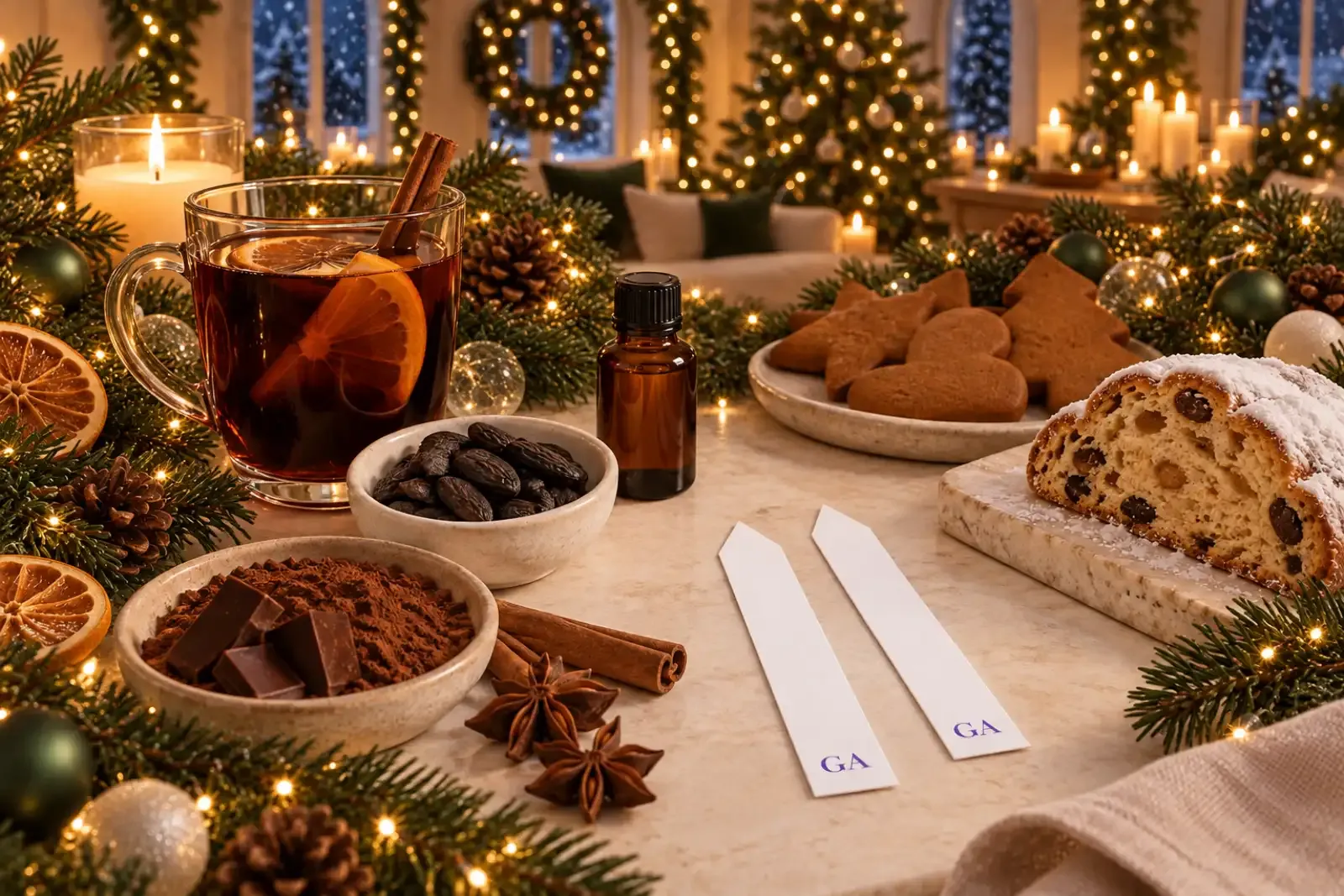
6. The smell of Christmas, taken apart by material
The smell of Christmas feels like one thing, but untangle it at the perfumer's bench and it turns out to be nothing more than a handful of materials and the molecules within them, layered together. Before comparing accords, let's look at the ingredients. Composition varies with origin and extraction method, so please read what follows as general tendencies.
Frankincense and myrrh, the first Christmas gifts
The Gospel of Matthew tells how the Magi offered the infant Jesus gold, frankincense and myrrh. Two of the three are aromatics. Frankincense is the resin of the Boswellia tree, found around Oman, Yemen and Somalia. It opens fresh, like lemon peel, and moves into pine resin, pepper and the smell of cool stone. It is rich in light molecules such as alpha-pinene and limonene. Myrrh is the resin of the Commiphora tree, darker and more bitter than frankincense. Furan-type molecules give it a deep smell reminiscent of mushrooms or leather.
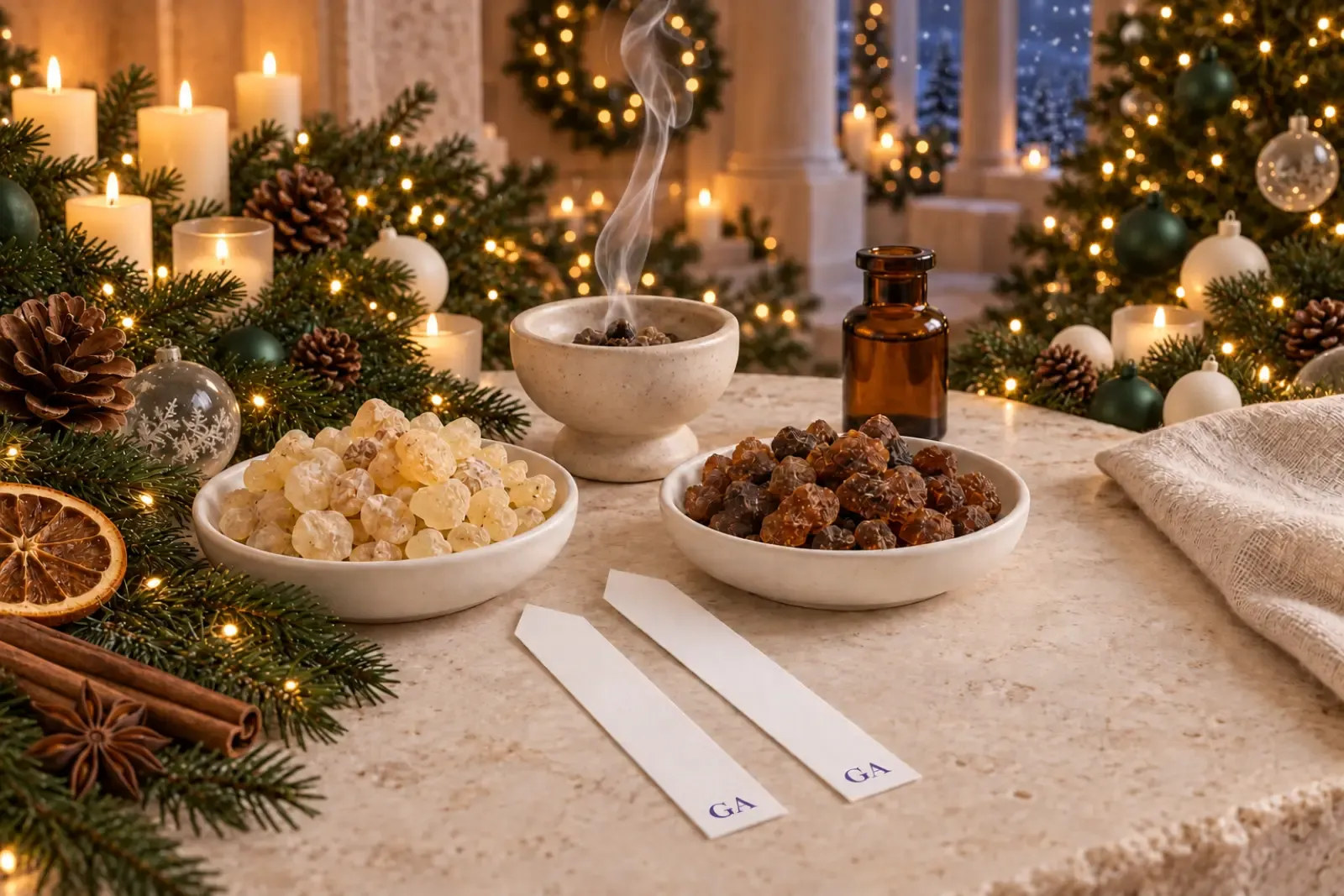
Fir: what a Christmas tree really smells of
The needles of fir and spruce are full of cool molecules such as alpha-pinene, beta-pinene and camphene. What turns an ordinary forest smell into "the smell of the tree" is bornyl acetate. It lays a soft, faintly sweet green over the smell of resin.
The spice drawer
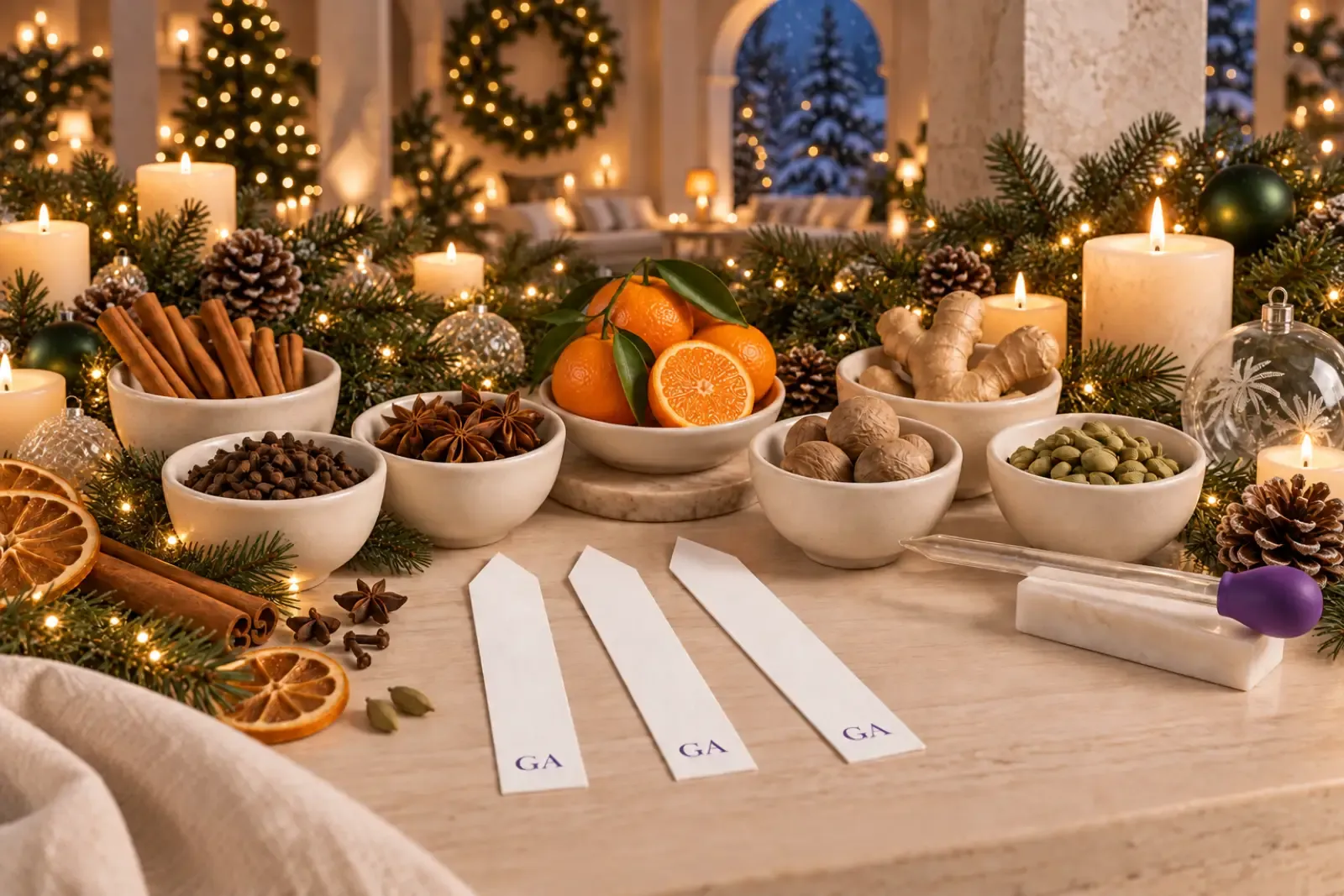
- Cinnamon: Bark oil is mostly cinnamaldehyde. Oil pressed from the leaves is rich in eugenol and smells closer to clove.
- Clove: Most of the bud oil is eugenol. That warm, slightly apothecary smell comes from here.
- Nutmeg: Sabinene and pinene, with myristicin added, give a warm, faintly sweet smell.
- Ginger: The aroma comes from components such as zingiberene. The pungent compounds barely evaporate, so the smell is far gentler than the taste.
- Cardamom: Eucalyptol and terpinyl acetate give it a smell that is cool and floral at once.
Orange and mandarin
Orange peel oil is mostly limonene. Yet limonene on its own does not smell of orange. It takes tiny amounts of aldehydes and components such as citral to produce the smell of a freshly peeled rind. Citral, incidentally, was the very first material we added to the GrassAccord Ingredient Dictionary.
The sweetness of winter
Vanillin sits at the heart of vanilla, but the depth of natural vanilla comes from hundreds of trace components. Tonka bean is rich in coumarin and smells like a blend of hay, almond and caramel. The smell of freshly baked biscuits or roasted nuts is made mostly by pyrazine-type molecules. When we say this year's gourmand is moving towards the nutty, at the perfumer's bench it also means using more of these baked and roasted smells.
7. Seven Christmas accords compared
Now it is time to put the ingredients together. We chose seven accords often used at Christmas and set out in turn their impression, their backbone materials, the components to check under EU labelling rules, and the direction they are likely to take within this year's trends. We have left out proportions and noted only the direction.
Orange spice (orange and clove)
- Impression: Bright, warm fruit and spice
- Backbone materials: Orange and mandarin peel, clove, a little cinnamon
- Components to check for labelling: Limonene, citral, eugenol
- Direction in 2026 (forecast): Fruit more vivid, clove a step back. Bringing out the bitterness of the peel
Glühwein (mulled wine)
- Impression: Red fruit, wine, warm steam
- Backbone materials: Red fruit, wine-effect materials, cinnamon, clove, star anise, orange
- Components to check for labelling: Cinnamal, eugenol, limonene
- Direction in 2026 (forecast): Sugar out, the wine's acidity and woodiness forward. The flagship of less-sweet gourmand
Gingerbread
- Impression: Baked dough, honey, spice
- Backbone materials: Ginger, cinnamon, clove, honey-effect materials, baked notes
- Components to check for labelling: Cinnamal, eugenol, coumarin (if tonka is used)
- Direction in 2026 (forecast): The brown baked crust rather than the white icing. The best fit for this year's taste
Fir forest
- Impression: Cold green forest, resin
- Backbone materials: Fir and spruce needles, balsam, a touch of wood
- Components to check for labelling: Limonene (depending on the needle oil), linalool
- Direction in 2026 (forecast): Less as a solo act, more as the cool lift over sweet notes
Cathedral frankincense
- Impression: Cool stone, smoke, lemon peel
- Backbone materials: Frankincense, myrrh, elemi, woods, amber
- Components to check for labelling: Limonene (naturally present in frankincense)
- Direction in 2026 (forecast): The deep resinous smell left by Middle Eastern taste carries on. Also mixed with gourmand as smoky vanilla
Roasted chestnut and praline
- Impression: Roasted nuts, butter, caramel
- Backbone materials: Roasted-nut-effect materials, caramel, vanilla, butter-effect materials
- Components to check for labelling: Varies by material. Check each material's composition sheet
- Direction in 2026 (forecast): The winter edition of the pistachio trend. Paired with salted caramel, the most 2026 holiday scent of all
Hot chocolate
- Impression: Cocoa, milk, a warm mug
- Backbone materials: Cocoa, milk- and cream-effect materials, vanilla, a little spice
- Components to check for labelling: Coumarin (if tonka is used), check each material
- Direction in 2026 (forecast): Lightened with mild notes such as milk or rice. A drop of saltiness at the end
Of the seven, five use at least one of cinnamon, clove, orange or tonka. In other words, a Christmas scent easily brings several components with it that must be labelled in Europe. And the Christmas accords that best fit this year's gourmand trend are gingerbread and roasted chestnut and praline. The traditional glühwein and hot chocolate, which lean heavily on sugar, need to be rebuilt with less sweetness to suit this year's taste.
Accords feel more like Christmas when they are layered rather than used alone. Open with fir forest, put gingerbread at the centre and lay cathedral frankincense underneath, and you get "an evening of baking in a room with a tree". Which accord you place at the top, the middle and the base becomes, quite literally, that scent's Christmas story.
8. Christmas smells different in every country
The same day is celebrated, but the smell of the table differs from country to country. Thinking of the winters of those reading this piece in 30 languages, we have picked a few.
- Germany and Austria — Glühwein, wine warmed with cinnamon, clove and orange. Lebkuchen, biscuits made with honey and spices.
- The Netherlands and Belgium — Speculaas biscuits blending cinnamon, clove, nutmeg, ginger and cardamom. St Nicholas' Day in early December.
- Sweden and the Nordics — Saffron buns for St Lucia's Day on December 13. Glögg, a warm drink with spices and raisins.
- Italy — Panettone studded with candied orange peel and raisins.
- Greece — Melomakarona, biscuits flavoured with honey, orange, cinnamon and clove.
- Poland — Poppy seed cakes and a dried-fruit drink at the Christmas Eve supper.
- Mexico — Ponche, a warm drink simmered from fruit, cinnamon and sugar cane.
- The Philippines — Bibingka, a rice cake eaten after the dawn Masses, baked in a mould lined with banana leaves.
- Japan — Christmas cake topped with strawberries and whipped cream.
- Australia and Brazil — Christmas in high summer. Mango and tropical fruit, sea breeze, the heat of the outdoors.
The Christmas smells of northern countries cluster around warming and baking, while those of the south are light, like fruit and breeze. It also stands out that many northern winter foods — like the Philippine rice cake or Europe's nut biscuits — overlap with the "nutty side" that this year's gourmand is heading towards.
9. Christmas in high summer
Singapore and Bangkok are still hot in December, and Sydney and São Paulo are in the middle of summer. In cities like these, a winter scent heavy with cinnamon and vanilla quickly feels stifling.
So in hot places, the same Christmas materials are used differently. Fir as a cool green, orange like freshly squeezed cold juice, spice no more than a light dusting of pepper. Frankincense, too, puts its lemon-peel side forward rather than its heavy side. The materials stay the same; only their weight and order change. If Gulf sales falter this year and Southeast Asia's share grows, it is worth preparing a separate "Christmas scent for hot countries" like this.
10. Christmas materials and Europe's new labelling rules
This is where you are most likely to hit a real-world problem when making a Christmas scent. Many of the materials that come to mind first at Christmas contain components the European Union has designated as potential allergens.
- Cinnamon → cinnamal, cinnamyl alcohol
- Clove and cinnamon leaf → eugenol, and its close relative isoeugenol
- Orange, mandarin and frankincense → limonene, citral
- Tonka → coumarin
- Many flowers and herbs → linalool
Above a certain concentration, these components must be named separately in the ingredient list. The threshold is 0.001% for leave-on products and 0.01% for rinse-off products. With its 2023 regulation, the European Union expanded the list from the original 26 substances to just over 80, and from July 31, 2026, newly launched products must be labelled according to the new list. If you bring back last year's Christmas scent as a new product this year, its ingredient list may change.
Being on the labelling list does not mean a material cannot be used. But this year's Christmas scent has to be made in the knowledge that its ingredient list will be longer. If you keep the labelling list and usage limits open beside you from the moment you choose materials, there will be less to rework later. Under the International Fragrance Association (IFRA) Standards, too, components such as cinnamal and isoeugenol have separate usage limits for each product type. The US does not yet have labelling rules like these, but it is moving in the same direction.
11. A 70-day preparation calendar
A perfume concentrate smells different on the day it is mixed and a few weeks later. Each revision means waiting that long again. Add the gift season's schedule on top, and you need to count backwards from Christmas. Below is a sample schedule drawn up from today so that you can ship from early December. Adjust maturation and shipping times to suit your product and region.
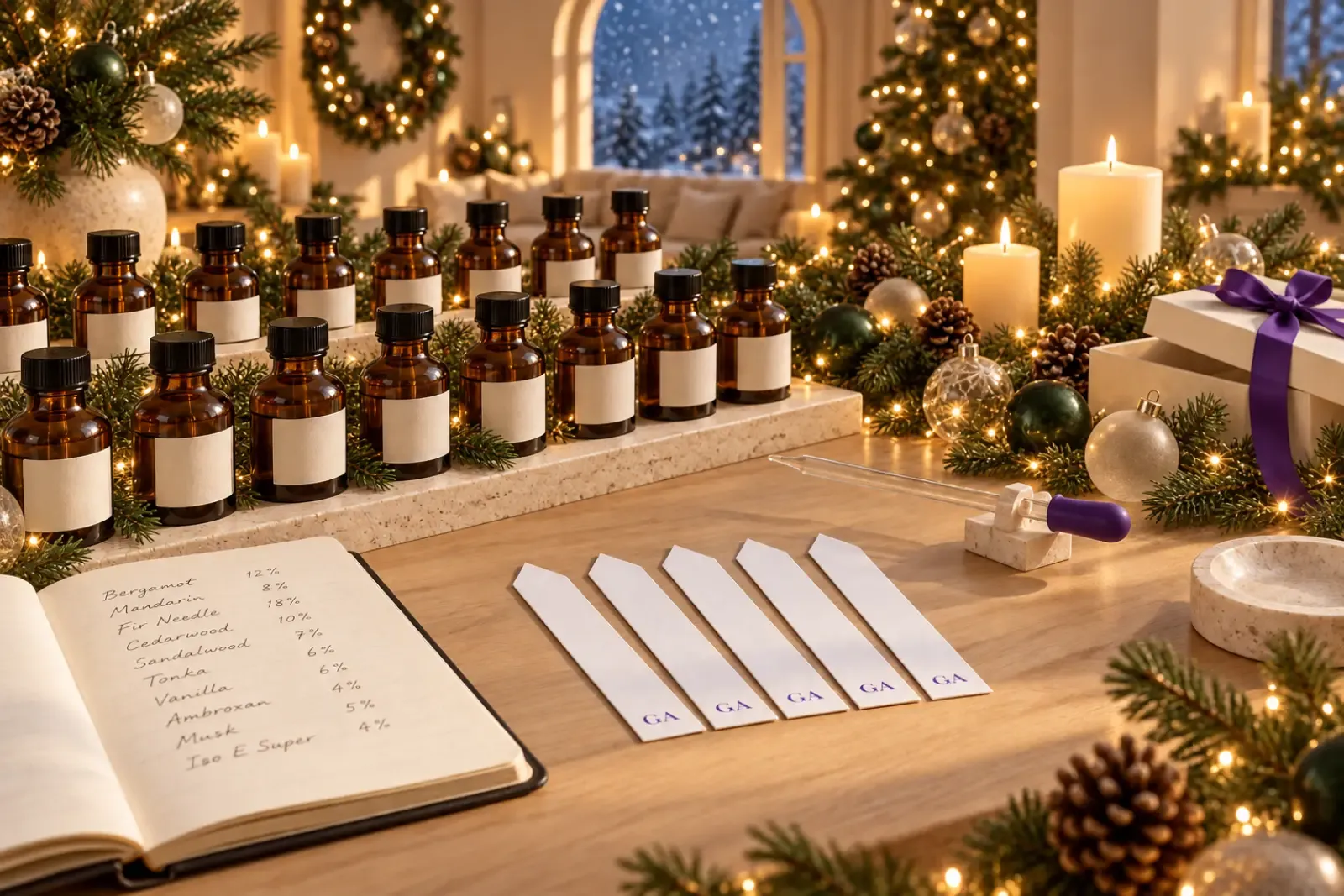
- Third week of October (now): Decide where the scent will be sold. Your starting point depends on whether it is a snowy winter or a midsummer Christmas. Choose a central accord from section 7 and settle on the formula you will start from. Winter materials can be hard to source just before the season, so it is best to place orders now.
- Fourth week of October: Mix two or three first drafts and start maturing them. Note down the labelled components and usage limits for each material as you go.
- First and second weeks of November: Compare the matured drafts on blotters and on skin, and pick one. Mature the revised concentrate again. Keep an eye on the mood around the November 11 shopping event in Asia.
- Third week of November: Finalise the concentrate. Prepare the ingredient list, bottle, box, photos and description. With customers choosing on their phones in mind, polish sentences that describe the scent as a taste or a scene.
- November 26–30: The week that brings together US Thanksgiving (26th), Black Friday (27th), the first Sunday of Advent (29th) and Cyber Monday (30th). Launch to coincide with this week, when holiday gift buying begins in earnest.
- First and second weeks of December: Take orders and ship. Remember country-specific dates too, such as St Nicholas' Day (5th–6th) and St Lucia's Day (13th). If you ship abroad, check each country's shipping deadline in advance.
- From the third week of December: Prepare small sizes or sample sets for late shoppers. Write down what you went through this season — it becomes the starting point for next Christmas.
12. Five things to keep in mind when building this year's Christmas scent
Less sugar, more baked and roasted
This year's gourmand leans towards the nutty and the salty rather than sugar. For gingerbread, bring the brown crust forward rather than the icing; for hot chocolate, the bitterness of cocoa rather than the sugar.
Don't leave the warmth to a single material
Build warmth from cinnamon alone and you will soon smell like a biscuit shop. Layer several spices in small amounts and let resins, woods and vanilla carry the warm body — it lasts longer. It also keeps labelled components from piling up in one material.
Make the first few minutes fresh
A winter scent that is heavy from the very first moment quickly tires. Open the first few minutes with the bright sides of orange, fir and frankincense, and let the warmth rise slowly.
Think about a rich version and a small version together
This season's gifts look set to split between "one good bottle" and "a small, easy bottle". Make a rich version and a lighter version on the same backbone, and one design gives you two kinds of gift.
Start from a formula and save one round of maturation
Balance between materials breaks easily in winter scents, and 70 days is short for many rounds of trial and error. Start from a single proven formula and adapt it little by little to your own winter, and you may wait one or two fewer rounds of maturation than if you worked out every proportion from scratch. With GrassAccord formulas, the PDF arrives by email as soon as you pay — choose one today and you can start blending today.
What to watch between now and Christmas
- Will Circana's third-quarter figures continue the "prices up, units flat" pattern for prestige fragrance?
- Will actual online sales on Black Friday and Cyber Monday match Adobe's forecasts ($12.9 billion and $15.1 billion)?
- How far will Gulf airports and duty-free recover in the peak holiday season? And how much of the gap will Southeast Asian hubs fill?
- Will the lawsuits over the new US tariffs be resolved before the holidays?
- Will this season's gourmand launches really come out less sweet and more nutty?
- Will Korea's perfume export records carry on into the holiday gift season?
Terms used in this piece
- Gourmand — A fragrance family that evokes things to eat, such as vanilla, caramel, coffee and nuts.
- Accord — A unit of scent in which several materials are blended so that they read as a single impression.
- Fine fragrance — Prestige scented products worn on the body, such as perfume. A term fragrance companies use when dividing their businesses.
- Like-for-like growth — Growth seen without currency changes or the effects of acquisitions and disposals.
- Resin — The sticky substance a tree releases to seal a wound. Frankincense and myrrh are the best-known examples.
- Allergen labelling — The list of fragrance components that must be named separately in the ingredient list above a certain concentration.
- IFRA — The International Fragrance Association. It sets the standards for usage limits of fragrance components.
- Formula — The blueprint that sets down which materials are blended in which proportions to make a scent. It is what GrassAccord sells.
In closing
Set last Christmas and this one side by side, and a great deal has changed. Perfume moved towards the more expensive and the smaller at the same time, Gulf duty-free went quiet, shipping perfume to the US became a harder calculation, and Europe's ingredient lists grew longer. And people's noses turned unusually towards the sweet and the nutty.
Some things have not changed. Just as two of the three gifts the Magi chose were aromatics, scent is still a gift that stays long in the memory. The first smell that rises when a box is opened comes back the following year, in the same season. Scent is a universal language, and Christmas is when that language travels the most.
The draft you mix today will take shape in November, and in December it will sit in someone's gift box and become part of their Christmas. We hope GrassAccord can be a good starting point for every perfumer preparing a winter scent of their own ahead of time. After Christmas, we will be back to see how many of these forecasts came true.
In 70 days, have a fragrant Christmas.
Sources: Circana holiday fragrance outlook (December 4, 2025), 2025 US beauty market results (February 10, 2026), first-half 2026 US beauty market results (August 11, 2026). Adobe Analytics 2025 holiday online sales and 2026 holiday forecast (September 2026). Deloitte 2026 holiday retail forecast (September 10, 2026). PwC 2026 holiday outlook (as cited in industry reporting). Givaudan January–September 2026 sales (October 13, 2026). LVMH Q3 2026 revenue (October 12). L'Oréal first-half 2026 results (July 29). Puig first-half 2026 results. Estée Lauder fiscal 2026 results (August 19, 2026). Glossy reporting on TikTok Shop fragrance sales (citing Charm estimates, March 31, 2026). Dubai Government Media Office announcement of Dubai Duty Free 2025 sales (January 1, 2026). eMarketer reporting on Singles' Day 2025. BeautyMatter reporting on Gulf airports and beauty sales (June 2026). US Supreme Court tariff ruling (February 20, 2026) and legal materials on tariffs under Section 301 of the Trade Act. Korea International Trade Association, Korea Customs Service and Ministry of Food and Drug Safety perfume export statistics (as reported). Mintel fragrance trends press release (June 17, 2025). Spate 2026 scent trends (April 13, 2026). Cosmetics Business reporting on gourmand (December 2025). Reporting on Madagascar vanilla prices. EU Regulation 2023/1545. International Fragrance Association (IFRA) Standards. Forecasts are GrassAccord's own judgement; information on tariffs and regulation is general information, not legal or tax advice.